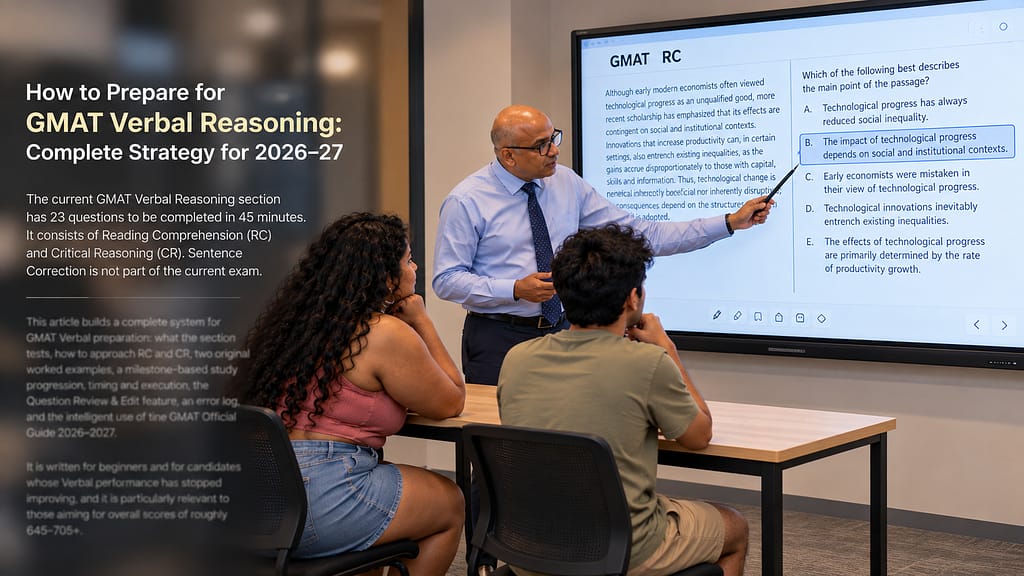
GMAT Verbal Reasoning preparation is not mainly about memorising grammar rules, vocabulary lists or speed-reading tricks. Candidates usually lose marks because they read without seeing structure, accept answers that sound reasonable but are not supported, or practise large volumes without learning from errors. The current GMAT Verbal Reasoning section has 23 questions in 45 minutes and contains Reading Comprehension (RC) and Critical Reasoning (CR). Sentence Correction is not part of the current exam.
The section rewards accurate comprehension, argument analysis, defensible inference, disciplined option elimination and execution under time pressure. This guide builds a complete system for beginners and for candidates whose Verbal performance has plateaued, including original RC and CR examples, timing, Question Review & Edit, an error log, milestone-based progression and intelligent use of the GMAT Official Guide 2026–2027.
For the broader exam-wide plan, see PREPON’s complete GMAT preparation strategy. For the other major reasoning-heavy section, continue with PREPON’s GMAT Data Insights preparation guide.
Exam-structure facts and feature descriptions in this guide follow current GMAC information. Timing ranges, readiness benchmarks, milestones and the PREPON Verbal Loop are PREPON strategic recommendations rather than GMAC rules.
GMAT Verbal Reasoning Preparation: Current Section at a Glance
| Feature | Current GMAT (2026–27) |
|---|---|
| Verbal Reasoning questions | 23 |
| Time | 45 minutes |
| Question types | Reading Comprehension and Critical Reasoning |
| Sentence Correction | Not part of the current exam |
| Verbal section score scale | 60–90 |
| Total Score scale | 205–805 |
| Score contribution | Quantitative Reasoning, Verbal Reasoning and Data Insights contribute equally to the Total Score |
| Format | Computer-adaptive |
| Section order | Candidate chooses the order of the three sections |
| Break | One optional 10-minute break |
| Review | Bookmark questions; if time remains at the end of a section, review and change up to three answers |
Unanswered questions can negatively affect your score. GMAC does not publish a formula showing a precise per-question penalty, so the practical lesson is simply to avoid leaving questions unanswered.
The exam is computer-adaptive, but GMAC does not disclose enough of the algorithm to justify claims about exactly how one response shapes what follows. Focus on solving each question as well as you can rather than trying to game an unpublished mechanism.
You may still see “GMAT Focus Edition” in older articles and videos. That was transitional terminology. Material built around the older 200–800 scale, a longer Verbal section or Sentence Correction should not be treated as a current-format guide.
What GMAT Verbal Actually Tests
Strong GMAT Verbal Reasoning preparation starts with understanding what the section is not. It is not a grammar examination, although command of written English still helps you follow dense sentences. It is not a vocabulary examination built around obscure words. It does not test prior academic knowledge, because the information needed to answer is supplied in the passage or argument. It is also not simply a reading-speed test.
A fluent English speaker can still struggle because GMAT answer choices exploit approximate understanding. A choice that is broadly in the spirit of the passage can still be wrong if it changes scope, strength or logical relationship. Conversely, a moderate-speed reader can perform strongly by identifying structure, locating evidence and eliminating choices precisely.
The PREPON Verbal Loop: Map → Task → Predict → Prove → Review
The PREPON Verbal Loop is the organising framework for both RC and CR. The first four steps guide the live attempt; Review turns practice into improvement.
If prediction fails, return to the map: inability to predict often signals incomplete structural understanding. Review then feeds back into future attempts by showing which step repeatedly breaks.
GMAT Reading Comprehension Strategy
In GMAT Verbal Reasoning preparation, RC should be read for structure first and detail second. For each paragraph, identify its job: introducing a phenomenon, presenting a view, complicating it, giving evidence, proposing an explanation or limiting a conclusion. Track the author’s purpose, separate competing viewpoints and notice directional words such as however, yet, although and by contrast.
A mental map is more useful than memorising details. Know where evidence lives so you can return to it. Rereading a specific line to confirm a claim is sound technique; repeatedly rereading because the passage was never mapped is not.
| RC family | What it asks | How to approach |
|---|---|---|
| Main Idea / Primary Purpose | The central point or why the author wrote the passage | Use the whole-passage map; reject answers that cover only one paragraph. |
| Detail | What the passage explicitly states | Return to the relevant lines and match meaning, not repeated wording. |
| Inference | What must be true or is strongly supported | Take only a small, defensible step beyond the text. |
| Function / Purpose | Why a detail, example or sentence appears | Identify what the detail does in its paragraph. |
| Application | How a principle or relationship applies to a new situation | Abstract the underlying principle, then match the same logic rather than the same topic. |
| Tone / Attitude | The author’s stance | Use evaluative language and qualification; be cautious with extreme choices. |
| Wrong-answer mechanism | What it looks like |
|---|---|
| Too broad | Covers more ground than the passage supports. |
| Too narrow | Accurately describes one detail but not the required whole. |
| Outside scope | Introduces a topic or claim the passage does not address. |
| Extreme | Uses absolute language where the passage is measured. |
| Reversal | States the opposite of the passage or reverses a relationship. |
| Distorted | Uses passage ideas but changes a qualifier or logical relationship. |
| Partly correct | Begins with support but adds an unsupported claim. |
| True but irrelevant | May be true but does not answer the question asked. |
Understanding the gist is not enough. General understanding can miss qualifiers, confuse a detail’s content with its function, or make a trap answer feel familiar. Treat every answer choice as a claim that must be proved from the passage.
Worked GMAT Reading Comprehension Example
Passage. Economists have long treated customer loyalty programmes as a straightforward device for increasing repeat purchases: by rewarding accumulated spending, a retailer raises the cost to the customer of switching to a competitor. Recent field studies, however, complicate this picture. In several studies, members spent more than non-members, but much of the gap was concentrated among customers who had already been frequent buyers before enrolling. These customers largely collected rewards for purchases they would have made anyway. Infrequent customers, the intended target, rarely accumulated enough points to redeem anything and often lapsed from the programme.
Some analysts conclude that such programmes are therefore wasteful. This inference is premature. The studies measured spending over a single year, whereas a principal benefit may be the data the programme yields. Enrolment records can reveal which products individual customers buy together, improving inventory planning and targeted promotions. Whether these gains outweigh reward costs has not been established, but a narrow focus on sales leaves the question open.
Map: Paragraph 1 presents the traditional view and then complicates it with evidence. Paragraph 2 presents the “wasteful” conclusion and rejects it as premature because the studies may have missed a data-related benefit. The author is cautious rather than pro- or anti-loyalty programme.
Question 1: Primary Purpose
The author’s primary purpose is to: (A) argue that retailers serving infrequent customers should abandon loyalty programmes; (B) present evidence that complicates a common view and suggest that a conclusion drawn from it is incomplete; (C) compare effects on frequent and infrequent customers; (D) explain how enrolment data improves inventory planning; (E) demonstrate that field studies are unreliable.
Correct answer: (B). It captures both major moves. (C) and (D) are too narrow, (A) reverses the author’s caution, and (E) overstates the criticism.
Question 2: Inference
Which can most reasonably be inferred? (A) Part of the spending gap is explained by pre-existing buying habits rather than the programme; (B) loyalty programmes do not increase infrequent-customer spending; (C) data-driven gains exceed reward costs; (D) frequent customers enrol more often; (E) most retailers have reduced promotional spending.
Correct answer: (A). The passage explicitly links much of the spending gap to customers who were already frequent buyers. (B) is too absolute, (C) contradicts the stated uncertainty, (D) is unsupported and (E) is outside scope.
GMAT Critical Reasoning Strategy
CR is the second pillar of GMAT Verbal Reasoning preparation. Every argument can be reduced to premises, a conclusion and the logical gap between them. Some arguments also contain an intermediate conclusion. Ask what the author is trying to convince you of, then identify what must connect the evidence to that claim.
Required assumptions are statements the argument depends on. Causal arguments deserve special scrutiny: correlation does not prove causation, and alternative explanations, reverse causation or a third factor can weaken a causal claim.
| CR family | Task | What the correct answer typically does |
|---|---|---|
| Assumption | Find what the argument requires | Bridges the gap; its negation damages the argument. |
| Strengthen | Make the conclusion more likely | Supports the assumption or rules out an alternative. |
| Weaken | Make the conclusion less likely | Attacks the assumption or supplies an alternative explanation. |
| Evaluate | Identify information that would help judge the argument | Targets a question whose answer could strengthen or weaken. |
| Inference | Find what is strongly supported | Follows closely from the statements without adding new claims. |
| Resolve the Paradox | Explain two facts that appear to conflict | Reconciles both without denying either. |
| Flaw / Method | Describe the weakness or argumentative technique | States the structural problem or method in abstract terms. |
Reading answer choices before understanding the argument creates avoidable confusion. A stronger sequence is: read the stem, analyse the argument, identify the conclusion and gap, predict the required direction, and then test the options.
Worked GMAT Critical Reasoning Example
Harbourline, a chain of 40 supermarkets, plans to replace most staffed checkout counters with self-checkout lanes. Its finance director argues that the change will lower total operating costs because, in a representative six-store pilot, cashier hours needed per week fell by roughly half after self-checkout lanes were introduced.
Which is an assumption? (A) Customers prefer self-checkout. (B) Installing and operating the lanes, together with any losses they cause, will not offset savings from reduced cashier hours. (C) Cashier wages will not rise. (D) Reduced-hour cashiers will be reassigned. (E) Self-checkout lanes occupy less floor space.
Correct answer: (B). The premise concerns one cost category, while the conclusion concerns total operating costs. The argument therefore requires other new costs not to cancel the labour saving.
Negation Test: If installation, operating costs and losses do offset the labour savings, the conclusion that total operating costs will fall collapses. The Negation Test is useful for required-assumption questions, but it is not a general tool for Strengthen or Weaken questions.
Vocabulary for GMAT Verbal Reasoning
GMAT Verbal does not normally justify GRE-style memorisation of rare-word lists. Prioritise vocabulary in context, regular exposure to academic business/science/social-science prose, and logical-relationship words.
| Function | Examples | What they signal |
|---|---|---|
| Contrast | However, yet, by contrast, conversely, whereas | A change in direction. |
| Concession | Although, notwithstanding, despite, admittedly | A point is granted before a different point is made. |
| Cause and consequence | Because, consequently, as a result, thereby | A causal relationship or claim. |
| Qualification | Some, many, most, often, may, tends to, largely | The strength and scope of a claim. |
| Addition and emphasis | Moreover, furthermore, indeed | Reinforcement of the preceding idea. |
When an unfamiliar word appears, use surrounding tone and grammatical function, keep building the passage map, and return only if a question genuinely turns on that word.
Milestone-Based GMAT Verbal Reasoning Preparation Plan
A calendar alone is a poor progression rule because candidates start at different levels. This GMAT Verbal Reasoning preparation plan advances by demonstrated behaviours. The readiness benchmarks are PREPON coaching guidance, not official GMAC requirements.
Around 75–80% accuracy on appropriately challenging untimed sets can be a useful coaching signal at Milestone 3, but it is not an official threshold. More important is that errors become diagnosable rather than random.
Candidates should move backwards when needed. If timed work causes accuracy to collapse, return to untimed reasoning or option elimination rather than rehearsing poor habits faster.
Choose the Right Path: RC-Strong, CR-Strong or Weak in Both
| Profile | Typical symptoms | Priority correction |
|---|---|---|
| RC strong, CR weak | Passages feel manageable, but two CR options often seem equally plausible. | Write the conclusion before options; practise premise-gap-conclusion analysis and Assumption prediction. |
| CR strong, RC weak | Arguments make sense, but passages feel dense and inference answers overreach. | Label paragraph roles; state author purpose; prove inference answers from specific lines; practise Application by abstracting the principle. |
| Weak in both | Timed performance is inconsistent and explanations feel surprising. | Pause aggressive timing; rebuild Milestones 1–3 with small untimed sets and detailed review. |
Academic reading is most useful when you summarise structure rather than facts. Ask what each paragraph is doing and how the writer’s position changes.
GMAT Verbal Timing Strategy
Timing is part of GMAT Verbal Reasoning preparation, but the arithmetic average of 45 ÷ 23 ≈ 1 minute 57 seconds is not a per-question rule. RC front-loads reading time because one passage supports multiple questions. Some CR questions will be faster; difficult inference or application questions may take longer.
| PREPON timing guide | Practical range / checkpoint |
|---|---|
| RC passage reading | Often around 2–3 minutes to build a usable map. |
| RC questions | Many around 1–1.5 minutes after the passage is mapped. |
| CR questions | Often around 1.5–2 minutes, with easier items faster. |
| Checkpoint around Q8 | About 16 minutes elapsed. |
| Checkpoint around Q16 | About 31 minutes elapsed. |
| Checkpoint around Q20 | About 39 minutes elapsed. |
Avoid the sunk-cost trap. If a question has stopped producing useful progress, make the best-supported choice, bookmark it if later review could genuinely help, and move on. Because unanswered questions can hurt the score, your end-of-section plan should ensure every question receives a response.
How to Use Question Review & Edit
The current GMAT lets you bookmark questions and, if time remains at the end of a section, review them and change up to three answers. GMAC presents this feature as a way to move on from uncertainty and return later.
| Moving on from genuine uncertainty | Deliberately careless first pass |
|---|---|
| You have analysed the question, narrowed the options and still cannot separate the final choices. | You skim, choose quickly without real analysis and assume you will repair the question later. |
| Protects time after productive reasoning has stalled. | Depends on time remaining and on one of only three answer changes. |
| Sensible when paired with selective bookmarking. | Not a sound plan. |
Bookmark questions with a specific doubt, not everything that feels difficult. On review, prioritise items where a fresh reading can reveal a concrete error, such as a missed qualifier, a misread stem or an overlooked premise. Change an answer because you found evidence, not because you feel nervous.
GMAC does not publicly disclose enough about the adaptive algorithm to justify claims about how an initially selected answer and a later edit interact with adaptivity. Do not build strategy on speculation.
Build a GMAT Verbal Error Log
An error log is one of the most useful tools in GMAT Verbal Reasoning preparation. Log wrong answers, lucky guesses, answers you cannot justify, excessively slow correct answers and correct answers reached through faulty reasoning.
| Error category | What went wrong | Example |
|---|---|---|
| Comprehension error | Misunderstood the passage or stimulus | Misread the author’s stance. |
| Argument-structure error | Misidentified premise, conclusion or intermediate conclusion | Treated a premise as the conclusion. |
| Question-stem error | Misread the task | Answered Strengthen as Weaken or missed EXCEPT. |
| Reasoning error | Used faulty logic | Assumed a causal link that was not established. |
| Assumption error | Chose something helpful rather than required | Missed the necessary bridge. |
| Option-elimination error | Removed the right option or retained a weak one | Reached two choices and selected the less supported one. |
| Trap-answer error | Fell for a known mechanism | Selected an extreme or too-narrow answer. |
| Vocabulary / context error | Misread a word or phrase in context | Misread a concession marker. |
| Timing error | Spent too long or rushed | Abandoned structure under pressure. |
| Execution / careless error | Knew the answer but selected incorrectly | Misclicked or misread an option. |
- What did I think? Record the actual reasoning.
- Why did it fail? Identify the precise failure point.
- What evidence supports the correct answer? Cite the passage line or logical link.
- What trap attracted me? Name the mechanism.
- What behaviour changes next time? Make the correction specific.
Why Your GMAT Verbal Score May Have Plateaued
A plateau usually means a specific bottleneck is limiting GMAT Verbal Reasoning preparation. More volume is rarely the first answer. Classify recent errors, compare timed and untimed performance, and target the largest recurring mechanism.
| Possible bottleneck | How it shows up | How to test it | What to do |
|---|---|---|---|
| Too much volume, too little review | Many questions done; repeated mistakes | Compare attempted questions with deeply reviewed questions | Reduce volume and increase review/reattempts. |
| Weak comprehension | Misreading across RC families | Do untimed passages and summarise paragraph roles | Return to mapping and academic reading. |
| Weak argument analysis | Conclusion or gap is hard to state | Write premise-gap-conclusion for 10 arguments | Practise structure before answering. |
| Assumption weakness | Assumption and Strengthen/Weaken accuracy is low | Predict assumptions before options | Use prediction and the Negation Test. |
| Poor option elimination | Frequently stuck between two | Explain why each rejected option fails | Write one-line eliminations and track traps. |
| Recurring trap attraction | Same trap types repeat | Tally trap categories | Add a deliberate check for that trap. |
| Premature timing | Untimed accuracy is much higher | Compare matched timed and untimed sets | Rebuild untimed reliability. |
| Poor pacing | Strong early, weak late | Record time and checkpoints | Rehearse pacing checkpoints. |
| Difficulty dependence | Moderate questions good, harder ones weak | Separate results by difficulty | Use targeted harder sets with deep review. |
| Fatigue / execution | Late-section or mock decline | Compare early and late accuracy | Build full-section stamina and refine section order/break use. |
How to Use the GMAT Official Guide 2026–2027
Official questions are a high-value resource for GMAT Verbal Reasoning preparation because they reflect actual GMAT style. The GMAT Official Guide 2026–2027 provides 975+ real GMAT questions, explanations, diagnostics and an online question bank with filtering and timed practice.
Working through the book once from page one treats official questions as a checklist. A better approach is targeted practice, deliberate review and reattempts. For the broader exam-wide sequence, see PREPON’s complete GMAT preparation strategy and study plan. For the third scored section, use PREPON’s GMAT Data Insights preparation guide.
Common GMAT Verbal Preparation Mistakes
- Skimming without understanding structure.
- Memorising passage details instead of building a map.
- Bringing outside knowledge into passage-based reasoning.
- Choosing what seems reasonable rather than what is supported.
- Failing to identify the CR conclusion.
- Confusing correlation with causation.
- Missing words such as EXCEPT, LEAST or NOT.
- Practising high volume without analysis.
- Introducing timing before fundamentals are reliable.
- Spending excessive time on one difficult question.
- Treating Question Review & Edit as a substitute for a serious first pass.
- Studying obsolete Sentence Correction material.
GMAT Verbal Myths vs Reality
| Myth | Reality |
|---|---|
| GMAT Verbal is basically an English test. | It tests comprehension and reasoning in English; Sentence Correction is absent. |
| You need an enormous vocabulary. | Contextual vocabulary and logical connectors matter more than rare-word lists. |
| Fast readers automatically perform well. | Accurate structure and elimination matter more than raw speed. |
| You should never reread a passage. | Targeted rereading to confirm evidence is good technique. |
| Every question should take exactly two minutes. | 1:57 is only the arithmetic average. |
| More questions always means a better score. | Improvement comes from analysis, targeted practice and reattempts. |
| You still need Sentence Correction. | Sentence Correction is not part of the current GMAT. |
| You can rush difficult questions because you can edit them later. | Moving on from genuine uncertainty is sensible; a careless first pass is not. |
GMAT Verbal Preparation for Indian Candidates
For Indian candidates, GMAT Verbal Reasoning preparation often comes with four recurring concerns: vocabulary anxiety, reading speed, outdated resources and attempts to translate current scores directly into the old scale. The methodology does not change by schooling background: learn structure, practise deliberately and analyse errors.
Do not treat a vast vocabulary list as the solution to RC. Improve contextual reading and logical connectors. If reading feels slow, improve structural comprehension before forcing speed. If a resource teaches Sentence Correction as part of the current Verbal section, a 36-question Verbal section or the old 200–800 scale, it is outdated for this purpose.
Current scores should be interpreted on the 205–805 scale and with current percentile information rather than through a simplistic old-score conversion.
Score Positioning for High GMAT Targets
Candidates aiming roughly at 645–705+ on the current scale should interpret those numbers using current GMAC percentile information. Verbal contributes equally with Quantitative Reasoning and Data Insights, so strong Verbal performance matters, but it is one of three equal contributors to the Total Score.
For admissions decisions, use the current requirements and class profiles of the programmes you are considering rather than assuming one GMAT number guarantees admission. If you want structured test preparation connected to international-management admissions, review PREPON’s MBA Abroad preparation programmes.
Your Complete GMAT Verbal Reasoning Preparation System
- Learn the current format: 23 questions, 45 minutes, RC and CR, no Sentence Correction.
- Use the PREPON Verbal Loop: Map, Task, Predict, Prove, Review.
- Build passage mapping and argument decomposition untimed.
- Learn recurring trap answers by name.
- Maintain an error log that includes lucky guesses and slow correct answers.
- Add timing gradually through short sets, mixed sets and full sections.
- Use Review & Edit selectively and change answers only for a reason.
- Diagnose plateaus before increasing practice volume.
- Use official material through targeted sets, review and reattempts.
- Integrate Verbal into full GMAT mocks and test section-order/fatigue effects.
The central idea behind GMAT Verbal Reasoning preparation is to build a repeatable decision system rather than collect tricks. If you are beginning from scratch, move through the milestones in order. If you are already accurate, shift toward timed mixed practice and execution. If you have plateaued, let the error log decide what you practise next.
You can also explore PREPON’s MBA Entrance Exams hub and complete blog archive for related strategy guides. For official exam structure, scoring and preparation resources, use the official GMAT Exam resources on mba.com.
Frequently Asked Questions About GMAT Verbal Reasoning Preparation
How do I prepare for GMAT Verbal Reasoning?
Learn the 23-question, 45-minute RC-and-CR format. Build passage mapping and premise-gap-conclusion analysis untimed, practise elimination, keep an error log, then add timing gradually before full sections and mocks.
Is GMAT Verbal difficult?
It is demanding because it tests reasoning under time pressure rather than specialist knowledge. Structured practice and evidence-based option elimination make the task more manageable.
What topics are tested in GMAT Verbal?
There are no content-specific subjects to memorise. Passages and arguments may use business, science or social-science contexts, while the tested skills are comprehension, argument analysis, inference and application.
Is Sentence Correction still in the GMAT?
No. The current Verbal Reasoning section contains Reading Comprehension and Critical Reasoning.
How much vocabulary do I need for GMAT Verbal?
Prioritise contextual vocabulary, logical connectors and regular academic reading rather than large lists of obscure words.
How can I improve GMAT Reading Comprehension?
Read for paragraph roles, author purpose, viewpoints and transitions. Predict before options and prove answers from the passage. Learn recurring wrong-answer mechanisms.
How can I improve GMAT Critical Reasoning?
Identify the conclusion, premises and gap before evaluating options. Predict the assumption or answer direction and use the Negation Test specifically for required-assumption questions.
How should I use the GMAT Official Guide for Verbal?
Start with diagnosis, then targeted untimed sets, deep review, reattempts, mixed practice, timed sets, full sections and mocks.
How do I improve my GMAT Verbal score if it has plateaued?
Tag recent errors, identify the largest recurring cluster, compare timed and untimed performance, and change one specific behaviour before re-measuring.
How many Verbal questions are on the GMAT?
Verbal Reasoning has 23 questions.
How much time do I get for GMAT Verbal?
You have 45 minutes. The arithmetic average is about 1 minute 57 seconds per question, but equal time per question is not required.
Should I guess if I am running out of time?
Yes. Unanswered questions can negatively affect the score. Eliminate what you can, choose the best-supported remaining option and ensure every question receives a response.
How does the adaptive format affect GMAT Verbal strategy?
Treat every question seriously and avoid trying to game the adaptive algorithm. GMAC does not publish enough detail to justify tactics based on predicting exactly how one answer changes later questions. Use sound reasoning, protect pacing and ensure every question receives a response.
How should I use Question Review & Edit in GMAT Verbal?
Bookmark questions where you have a specific unresolved doubt. If time remains at the end of the section, review those questions selectively. You may change up to three answers, so change an answer because you found clearer evidence or a reasoning error, not simply because you feel uncertain.
When should I start timed GMAT Verbal practice?
Start controlled timing after your untimed reasoning is reasonably dependable. Build passage mapping, argument analysis and option elimination first, then progress through short timed sets, mixed RC and CR sets, complete 45-minute Verbal sections and full GMAT mocks.
Should I focus more on Reading Comprehension or Critical Reasoning?
Related PREPON guides: TOEFL Preparation Guide
Prioritise the area producing the larger and more consistent error cluster. If RC is weaker, work on passage structure, evidence and inference control. If CR is weaker, work on premise-conclusion analysis, assumptions and logical gaps. Continue mixed practice so the stronger area remains stable.