Research cut-off: 27 October 2026 | Target cycle: MBA/PGDM 2027–29 | By PREPON, Results. Not Just Resources.
Many MBA aspirants prepare for a conventional Group Discussion and then find a different task waiting for them. It might be a budgeting puzzle, a creative design brief, a 90-second presentation, a recorded video or a group interview. These formats test the same qualities as a GD: clear thinking, collaboration and judgement. They test them in different ways.
This guide explains how group exercises in MBA admissions work, which institutions use them, and how to prepare for related selection formats. It separates what is officially confirmed for 2027 from what candidates have reported in earlier years. It also gives you six fully worked practice simulations, a solving framework, a self-scorecard and two preparation plans.
A note on how this article treats evidence. Facts about the 2027 cycle are linked to official pages. Past candidate accounts are labelled as historical. All worked examples are original PREPON training simulations. None is an actual past question from any institute.
1. Quick Answer: What Are Group Exercises in MBA Admissions?
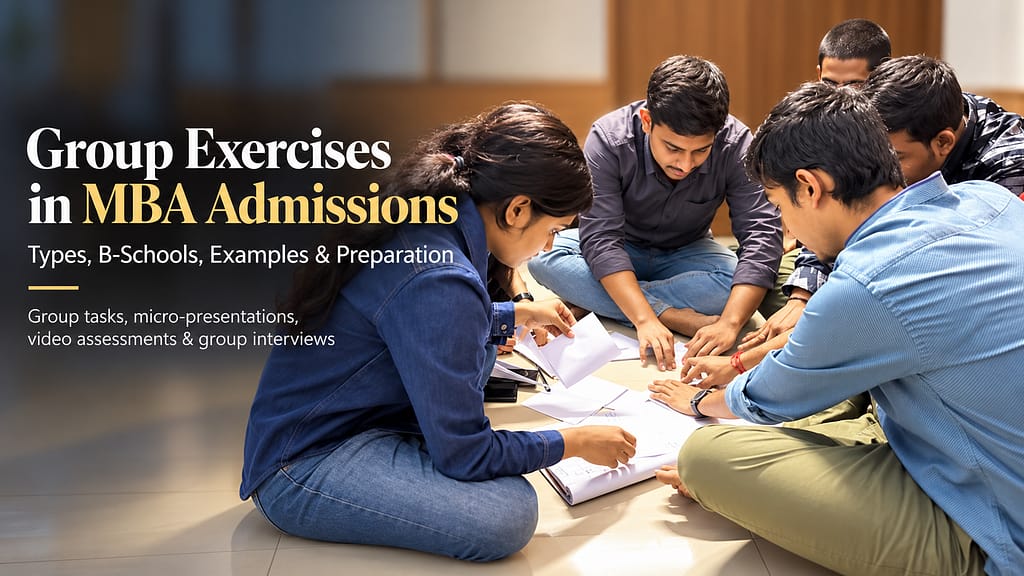
A group exercise is a selection task in which a small group of candidates must work together on a problem, task or creative brief. Assessors observe how each candidate thinks, listens, contributes and handles the group.
In a typical GD, you discuss a topic and may not need to produce anything. In a group exercise you usually have to produce something: a ranking, a budget, a plan, a design, a story, a skit or a recommendation. The output matters. The way you reach it matters more.
Group exercises sit alongside related assessments: micro-presentations, extempore speaking, video introductions and group interviews. Which of these you face depends on the institute, the programme and the year. Always check the current admissions page of each institute you are shortlisted for.
2. Why Group Exercises Differ from Conventional GDs
PREPON’s existing guide on Group Discussion for MBA Admissions covers GD theory. This article does not repeat it. Understanding group exercises in MBA admissions begins with the following practical differences.
| Aspect | Conventional GD | Group Exercise |
|---|---|---|
| Core task | Discuss an opinion-based or factual topic | Solve, plan, design, rank or create |
| Output | Usually none; a conclusion may be summarised | Often a shared deliverable (ranking, plan, pitch, story) |
| What gets tested | Content, articulation, structure | Collaboration, problem-solving, adaptability, execution |
| Role of materials | Rarely any | Frequently: cards, data, images, props |
| Common failure | Dominating or staying silent | Arguing without deciding; ignoring constraints; running out of time |
The skills overlap, but the behaviours that earn credit shift. In a GD, a sharp point can carry you. In a group exercise, a sharp point that never becomes part of the group’s output helps little. The most reliable approach to group exercises in MBA admissions is to create a shared, defensible outcome rather than maximise individual speaking time.
3. Types of Alternative MBA Admissions Assessments
Institutes use several formats beyond the standard GD. A preparation plan for group exercises in MBA admissions should also distinguish individual oral and recorded assessment rounds.
- Group Exercise (GE): a collaborative task with a group output.
- Micro-Presentation (MP): a very short individual presentation, often about 90 seconds.
- Extempore: an individual talk on a topic given with little or no preparation time.
- Written Assessment: a short, timed writing task.
- Video Introduction or Video Essay: a recorded response, either submitted in advance or given live online.
- Group Interview (GI): panel questioning of several candidates together.
- Personal Interview (PI): a one-to-one conversation. It is a separate assessment and often follows a GE or GD.
4. Which B-Schools Conduct Which Assessments?
Reading the comparison table below, pay attention to the Evidence Status column. It tells you how much weight to give each row.
Evidence status key
- Officially confirmed for 2027: stated on an official 2027–29 admissions page.
- Confirmed for an earlier cycle: officially stated for a past year, not re-verified for 2027.
- Historical candidate-reported format: described by candidates or prep websites; not official.
- Specific format not publicly established: the institute may use such rounds, but no reliable detail is available.
| Institution | Programme | Assessment Round | Actual or Reported Format | Admission Year | Evidence Status | Preparation Priority |
|---|---|---|---|---|---|---|
| MICA Ahmedabad | PGDM / PGDM-C | Group Exercise + Personal Interview | GE and PI confirmed. Specific creative tasks are not officially prescribed | 2027 | Officially confirmed for 2027 (GE and PI only) | High: collaboration, creativity, communication |
| SIBM Pune | MBA | GE-PI for shortlisted candidates | Online GE-PI; published dates 3–7 and 10–14 February 2027 | 2027 | Officially confirmed for 2027 | High: online group behaviour, structured thinking |
| SCMHRD Pune | MBA, MBA (BA), MBA (IDM) | GE and PI | GE-PI dates in January–February 2027, varying by programme | 2027–29 | Officially confirmed for 2027 | High: do not assume identical tasks across programmes |
| CHRIST University | MBA | GD (25 min/group), Micro-Presentation (90 sec/student), Written Assessment (up to 10 min), PI | Topics for MP come from the university’s published 2027 list; first GD/MP session 31 January 2027 | 2027 | Officially confirmed for 2027 | High: MP structure, timed delivery |
| SPJIMR Mumbai | PGDM | Two-round interview-based selection | Official page confirms two interview rounds. Group Interview details are candidate-reported (GI-1, GI-2) | 2027–29 | Official: two interview rounds. Historical candidate-reported: group-interview details | High: listening, situational judgement |
| Masters’ Union | PGP Rise General Management | Application essay | Choice of two-minute video essay or written essay up to 200 words | Current programme page | Officially confirmed (programme-specific) | Medium: video skills if you choose that option |
| SIIB Pune | MBA (International Business) | GE-PI | Blindfolded group activity (locating a rope and forming a square) reported historically | Earlier cycles | Historical candidate-reported format | Low for the specific task; useful for coordination practice |
| SIMC Pune | MBA-related programmes | GE-PI reported | Specific non-GD task not established from the sources used here | Earlier/current cycle not independently confirmed here | Specific format not publicly established | Check official admissions instructions; practise creativity and teamwork |
| SIOM Nashik | MBA Operations Management | GE-PI reported | Historical candidate account describes image interpretation; current task unknown | Historical account: 2025 | Historical candidate-reported format | Visual interpretation and structured discussion |
| SCIT Pune | MBA ITBM / related programmes | GE-PI reported | Historical ethical-case exercises are reported; precise brief unverified | Earlier cycles | Historical candidate-reported format | Ethical reasoning and adaptable case analysis |
| SIMS Pune | MBA | GE-PI reported | Historical collaborative storytelling account; precise brief unverified | Historical account: 2025 | Historical candidate-reported format | Visual storytelling and group presentation |
| SIDTM Pune | MBA Digital & Telecom Management | GE-PI reported | Specific non-GD task not established from sources used here | Current cycle not independently confirmed here | Specific format not publicly established | Group problem-solving; verify current instructions |
| SSBF Pune | MBA Banking & Finance | GE-PI reported | Specific non-GD task not established from sources used here | Current cycle not independently confirmed here | Specific format not publicly established | Collaborative reasoning; verify current instructions |
| K J Somaiya Institute of Management | MBA | Problem Situation Analysis reported | Do not assume the task is collaborative | 2027 process requires primary-source recheck | Specific format not publicly established here | Written case-analysis skills |
| NMIMS Mumbai | MBA | Case Discussions reported historically | Historical process does not establish a current group round | Historical | Historical candidate-reported format | Verify current selection stages |
| IMT Ghaziabad | PGDM | Critical-thinking/case assessment reported | Format and applicability require current official verification | Earlier cycles | Specific format not publicly established | Case analysis; verify current instructions |
| IRMA Anand | Management programme | Rural/social case discussion reported | Specific present-cycle case format not verified here | Earlier cycles | Specific format not publicly established | Rural development and case reasoning |
| IIM Nagpur | MBA | Extempore during PI reported | Timing and 2027 status not independently established here | Earlier cycles | Specific format not publicly established | Timed individual speaking |
| Alliance University | MBA | Extempore reported | Programme and cycle details require confirmation | Earlier cycles | Specific format not publicly established | Timed individual speaking |
| JAIN (Deemed-to-be University) | MBA | Extempore reported | Timing and current requirements need official recheck | Earlier cycles | Specific format not publicly established | Impromptu speaking |
| RV Institute of Management | MBA | GD or extempore reported | Selection alternative and 2027 applicability require confirmation | Earlier cycles | Specific format not publicly established | Prepare both formats |
| IIT Jodhpur (SMEE) | Management programme | Video assessment possible | Needs primary-source verification | Not specified | Specific format not publicly established | Verify on the official site |
Official sources: MICA 2027, MICA PGDM, SIBM Pune dates, SCMHRD MBA (BA), CHRIST process, CHRIST dates, SPJIMR PGDM, Masters’ Union PGP Rise.
Two cautions follow from this table.
- Where a row says "not publicly established", prepare general skills. Do not invent a specific task format for that college.
- Formats change from year to year. Treat any historical entry as a flavour of what could happen, not a forecast.
5. Sixteen Group Exercise Formats, Organised into Families
Below is a practical taxonomy of the formats candidates may encounter in group exercises in MBA admissions. It is a PREPON teaching classification. It is not an official list from any institute. Each family names the formats it contains, then covers what happens, the skills it shows, how to approach it and the typical mistakes.
Family A: Analytical Decision Tasks
Formats: (1) Business case problem-solving, (2) Prioritisation and ranking, (3) Resource allocation and budgeting, (4) Group planning and sequencing, (16) Changing-constraints decision-making.
- What happens: The group receives a scenario with data, options or constraints and must reach a shared decision, ranking or plan within a time limit.
- Possible materials: Fact sheets, tables, cards, cost lists.
- Expected output: A ranked list, an allocation table, a sequenced plan or a written or spoken recommendation.
- Skills shown: Structured thinking, numerical comfort, trade-off reasoning, adaptability.
- Approach: Use the FACT framework (Section 8). Agree the objective first. List alternatives. Apply constraints. Choose using visible criteria.
- Frequent mistakes: Jumping to a favourite option, skipping the arithmetic, treating a new constraint as a reason to restart instead of revise.
- Illustrative task (PREPON simulation): "Rank six causes of customer complaints and justify the order."
Family B: Creative and Communicative Tasks
Formats: (5) Creative product design, (6) Advertising and campaign creation, (7) Collaborative storytelling, (8) Image-based or visual interpretation, (9) Skits and role-playing.
- What happens: The group builds a concept, story, campaign or performance around a brief or a set of prompts.
- Possible materials: Paper, markers, pictures, objects, word cards.
- Expected output: A pitch, a storyboard, a story told in turns, or a short performance.
- Skills shown: Ideation, building on others’ ideas, audience focus, clear delivery.
- Approach: Define the user or audience first. Generate several ideas quickly. Pick one by feasibility. Assign roles. Rehearse transitions.
- Frequent mistakes: Falling in love with the first idea, letting one person decide everything, over-designing the concept and under-preparing the delivery.
- Illustrative task: "Design a low-cost product for first-year students to manage money."
Family C: Interpersonal and Ethical Tasks
Formats: (10) Negotiation and conflict resolution, (11) Ethical decision-making, (12) Crisis-response simulations, (13) Survival and disaster prioritisation.
- What happens: Stakeholders have competing interests, or the group must prioritise under risk or urgency.
- Expected output: A negotiated settlement, a response plan or a justified ranking of actions or items.
- Skills shown: Stakeholder thinking, ethical reasoning, composure, concise justification.
- Approach: List stakeholders and what each needs. Separate facts from assumptions. Compare options by harm, feasibility and fairness. Choose a defensible course and state the risks.
- Frequent mistakes: Choosing the "heroic" answer without costing it, ignoring a stakeholder group, giving a moral lecture instead of a decision.
- Illustrative task: "A supplier flags a labelling error on a batch already shipped. Decide the response."
Family D: Coordination and Play-Based Tasks
Formats: (14) Physical and spatial coordination, (15) Collaborative puzzles and games.
- What happens: The group must solve a physical or puzzle-like task together, often with limited communication or materials.
- Skills shown: Clear instruction-giving, listening, patience, leadership without dominance.
- Approach: Agree on one voice for instructions. Check understanding by repeating back. Pause and reassess when progress stalls.
- Frequent mistakes: Everyone speaking at once, treating the activity as a joke, going silent after a failed attempt.
- Illustrative task: "Arrange cards in a sequence when each member can see only some of them."
Reported example, labelled carefully. A historical candidate account describes a SIIB Pune activity in which blindfolded candidates located a rope and formed a square. See the historical references in the references section. This should not be assumed for the current cycle. The useful lesson is general: when information is distributed and vision is limited, clear and calm instruction-giving is the observable skill.
6. Documented Historical Group Exercise Experiences
Candidate accounts are useful for understanding the flavour of group exercises in MBA admissions, but they are not official records.
| Institute | What candidates have broadly described | How to use it |
|---|---|---|
| MICA Ahmedabad | Creative and collaborative tasks (candidate accounts describe task types such as design and presentation exercises) | Practise collaborative creative briefs. Do not claim any specific task is prescribed for 2027 |
| SIBM Pune | Group tasks within GE-PI | Practise structured prioritisation, and rehearse for an online format |
| SCMHRD Pune | GE and PI, with variation by programme and session | Practise both planning and allocation tasks |
| SIIB Pune | Blindfolded rope-and-square activity | Practise coordination; do not memorise details |
Where such tasks are useful for learning, they appear below as original PREPON simulations with fictional briefs.
7. Six Worked PREPON Simulations
Every example below is an original PREPON training simulation for group exercises in MBA admissions. None is a past question from any institute. Numbers and facts are fictional.
Example 1: Resource Allocation
Brief. A mid-sized retail company has a ₹60 lakh improvement budget. Five proposals compete for it.
| Project | Cost (₹ lakh) |
|---|---|
| A. Mobile app upgrade | 25 |
| B. Staff training programme | 15 |
| C. New warehouse module | 30 |
| D. Festival marketing campaign | 20 |
| E. Customer helpline expansion | 10 |
| Total requested | 100 |
Constraints. The budget is ₹60 lakh. Projects cannot be split unless stated. The group has 15 minutes and must give a single recommendation.
Group workflow.
- Agree the objective: improve customer retention in the next year (Facts).
- Agree criteria and weights: impact 40%, urgency 25%, feasibility 20%, cost-efficiency 15%.
- Score each project 1–5 and compute weighted scores.
- Fund in score order until the budget runs out. Then examine the leftover.
Worked reasoning.
| Project | Impact (40%) | Urgency (25%) | Feasibility (20%) | Cost-efficiency (15%) | Weighted score |
|---|---|---|---|---|---|
| E. Helpline | 4 | 5 | 5 | 5 | 1.60 + 1.25 + 1.00 + 0.75 = 4.60 |
| B. Training | 3 | 4 | 5 | 4 | 1.20 + 1.00 + 1.00 + 0.60 = 3.80 |
| A. App | 4 | 3 | 4 | 3 | 1.60 + 0.75 + 0.80 + 0.45 = 3.60 |
| C. Warehouse | 5 | 2 | 2 | 2 | 2.00 + 0.50 + 0.40 + 0.30 = 3.20 |
| D. Marketing | 3 | 2 | 4 | 3 | 1.20 + 0.50 + 0.80 + 0.45 = 2.95 |
Funding in order: E (10) + B (15) + A (25) = ₹50 lakh. ₹10 lakh remains. C needs 30 and D needs 20, so neither fits.
Trade-off. Funding C instead of A would give E + B + C = ₹55 lakh. It would add the highest single-impact score but sits lowest on urgency and feasibility. The group prefers A.
Sample final output. "We recommend E, B and A for ₹50 lakh. We retain the unallocated ₹10 lakh as a contingency reserve. Because projects cannot be split, we do not partially fund D. C is deferred because of lower urgency and feasibility this year."
Observable good behaviours. Someone proposes criteria before scoring. Weights are agreed, not imposed. The leftover budget is addressed explicitly.
Common errors. Choosing by gut feeling. Forgetting to total costs. Ignoring the leftover.
Faster approach. Skip full scoring if the group has under 10 minutes: rank by urgency first, then check cost fit.
Mini self-assessment. Did we state the objective? Did the arithmetic reconcile? Did every member’s view enter the scoring?
Example 2: Prioritisation and Ranking
Brief. A food-delivery start-up has rising complaints about late deliveries. Six factors may contribute. The group must rank them from most to least important to address.
Constraints. 12 minutes. One agreed ranking. Disagreement must be settled by criteria, not by volume.
Group workflow. Agree three criteria: frequency, controllability by the company and impact on customers. Score each factor 1–3 on each. Agree in advance that ties are broken by impact.
Worked reasoning.
| Factor | Frequency | Controllability | Impact | Total |
|---|---|---|---|---|
| Rider shortage at peak hours | 3 | 3 | 3 | 9 |
| Restaurant preparation delays | 3 | 2 | 3 | 8 |
| Inaccurate delivery-time estimates | 3 | 3 | 2 | 8 |
| App glitches | 1 | 3 | 3 | 7 |
| Bad weather | 2 | 1 | 2 | 5 |
| Customer address errors | 2 | 2 | 1 | 5 |
Ties: restaurant delays and inaccurate estimates both total 8. The pre-agreed tie-break is impact, so restaurant delays rank second (impact 3 versus 2). Weather and address errors both total 5. Weather has the higher impact (2 versus 1), so it ranks fifth.
Final ranking: 1) Rider shortage, 2) Restaurant delays, 3) Inaccurate estimates, 4) App glitches, 5) Weather, 6) Address errors.
Sample final output. "Our priority is rider availability, then restaurant prep time, then estimate accuracy. Weather ranks low because the company cannot control it."
Observable good behaviours. The tie-break rule was set before scoring. A quiet member is asked for their score.
Common errors. Debating each factor at length without criteria. Letting the most confident voice settle ties.
Faster approach. Agree one criterion and one tie-break, then rank in two minutes.
Mini self-assessment. Would a neutral observer reach the same ranking from our criteria?
Example 3: Collaborative Creative Task
Brief. Design a board game that teaches first-year college students basic personal finance. The group must pitch it in two minutes after 12 minutes of preparation.
Constraints. Low production cost. Playable in 20 minutes. Suitable for 3–5 players.
Group workflow.
- User needs (2 min): Students have irregular pocket money, impulse spending and little savings knowledge.
- Ideation (3 min): Each member offers one idea. Options: a "budget month" simulation, an investment race, a bill-paying quest.
- Selection (2 min): Choose by feasibility. The budget-month simulation wins because it is simple and links to real life.
- Role allocation (1 min): One member explains rules, one describes the learning outcome, one covers cost and distribution, one closes.
- Pitch rehearsal (2 min): Agree transitions.
Worked reasoning. The group chooses a game where each player gets a fictional monthly allowance, draws event cards ("friend’s birthday", "phone repair", "scholarship bonus") and must end with savings. The learning outcome is the trade-off between wants, needs and emergencies. Production is a printed board and cards, which keeps cost low.
Sample final output. "Our game, Month Master, lets players manage a fictional month of expenses through event cards. It teaches budgeting and emergency saving in 20 minutes at a very low print cost."
Observable good behaviours. The group starts with the user. Ideas are combined, not just voted on. Every member speaks in the pitch.
Common errors. Designing a complicated game no one could explain in two minutes. Spending most of the time on the name and artwork.
Faster approach. Fix the learning goal first, then pick the simplest mechanic.
Mini self-assessment. Could a stranger understand our concept in one sentence?
Example 4: Changing-Constraints Exercise
Brief. Plan a two-day corporate offsite for 40 employees with a budget of ₹4 lakh.
Phase 1 information.
| Option | Venue type | Cost per person | Notes |
|---|---|---|---|
| A | Resort, 3 hours away | ₹8,000 | Transport extra: ₹50,000 total |
| B | City hotel | ₹6,500 | Local, no transport cost |
| C | Company campus with external trainer | ₹3,000 | Trainer fee ₹80,000 total |
Phase 1 reasoning.
- A: 40 × 8,000 = ₹3,20,000, plus ₹50,000 transport = ₹3,70,000. Within budget.
- B: 40 × 6,500 = ₹2,60,000. Within budget.
- C: 40 × 3,000 = ₹1,20,000, plus ₹80,000 = ₹2,00,000. Within budget.
The group’s goal is team bonding with a manageable budget. It recommends A, because the resort supports bonding and still fits the budget.
Phase 2 (new information announced after 10 minutes): Headcount rises to 52 and the budget falls to ₹3.5 lakh.
Revised reasoning.
- A: 52 × 8,000 = ₹4,16,000, plus transport. Exceeds the budget.
- B: 52 × 6,500 = ₹3,38,000. Within ₹3.5 lakh.
- C: 52 × 3,000 = ₹1,56,000, plus ₹80,000 = ₹2,36,000. Within budget, but weaker on bonding.
Revised recommendation: Option B. The goal (bonding) is unchanged, so the group keeps the criteria and changes the choice only because the numbers changed.
Sample final output. "Given the new headcount and budget, we revise from A to B. B costs ₹3.38 lakh, leaving ₹12,000 for contingencies. C is a fallback if costs rise further."
Observable good behaviours. The group recalculates before arguing. It explains why the recommendation changed. It reaffirms the objective.
Common errors. Defending the original answer out of pride. Restarting from scratch and losing time.
Faster approach. Keep a one-line record of the objective and criteria. A new constraint then only needs a re-run, not a new discussion.
Mini self-assessment. Did we revise the decision without losing the logic?
Example 5: Group Storytelling or Role Play
Brief. Create a coherent story using five words: bridge, notebook, monsoon, stranger, promise. Five members, six minutes total: two to plan and four to tell.
Constraints. Every member must speak. The story needs a beginning, a turning point and an ending. All five words must appear.
Group workflow.
- Agree a one-line arc: A student crossing a flooded bridge meets a stranger and keeps a promise.
- Assign roles: Opener (setting), Developer 1 (conflict), Developer 2 (stranger’s role), Twist (the notebook’s secret), Closer (the promise kept).
- Agree handover cues, such as ending each part on an open question.
Sample output structure.
- Opener: "During the monsoon, Riya had to cross the old bridge to reach her exam."
- Developer 1: "The river had risen, and the bridge was closed."
- Developer 2: "A stranger offered to guide her along a safer path."
- Twist: "In return he asked her to deliver a notebook to his daughter."
- Closer: "Riya wrote her exam, then kept her promise. The notebook held his lifelong sketches."
Observable good behaviours. Planning is brief and everyone knows their part. The transitions are smooth and each person builds on the previous line.
Common errors. Everyone planning their own story. One person narrating most of it. Forgetting required words.
Faster approach. Fix the ending first, then work backwards to the setup.
Mini self-assessment. Did all five words appear? Did each speaker add something new?
Example 6: Ethical or Crisis Decision-Making
Brief. A packaged-food company discovers that one production batch may lack an allergen warning on its label. About 30% of the batch has already shipped, and it is festival season. The group must recommend a course of action.
Constraints. Limited information. Regulatory and legal specifics are not given, so the group must not invent them. Ten minutes.
Group workflow.
- Facts: One batch, label issue suspected, partial shipment, festival demand.
- Stakeholders: Consumers (especially people with allergies), retailers, employees, regulators, the company.
- Alternatives: (a) Continue and hope no one is affected. (b) Halt remaining stock only. (c) Halt the batch, alert retailers, and arrange a targeted recall with a public advisory.
- Constraints: Time, reputation, cost, and the duty to protect consumers.
- Trade-offs: Option (a) has the lowest short-term cost but the highest potential harm. Option (b) protects future customers but leaves shipped units exposed. Option (c) costs more now but addresses the actual risk.
Worked reasoning. Because the potential harm affects health, the group weights safety above short-term cost. Option (c) is the most defensible. The group also states what it does not know, namely the exact legal obligations, and asks the legal and quality teams to confirm them.
Sample final output. "We recommend halting the remaining batch, informing retailers immediately and issuing a targeted recall and public advisory for the shipped units. We will consult legal and quality teams on formal requirements, and we will communicate openly with customers."
Observable good behaviours. The group names the facts and the unknowns separately. It does not claim certainty about regulations. It gives reasons for its choice.
Common errors. Delivering a moral lecture without a decision. Ignoring cost. Inventing legal details.
Faster approach. Ask first, "What is the worst credible harm?" That usually fixes the priority.
Mini self-assessment. Is our decision defensible to a customer, a regulator and an employee?
8. The FACT Framework for Group Exercise Problem-Solving
FACT is a PREPON teaching framework. It is not an official assessment method used by any B-school.
| Step | Meaning | What to do |
|---|---|---|
| F: Facts & Objectives | What is known, what is assumed, what success means | Restate the task. Agree the goal in one sentence. Separate facts from assumptions |
| A: Alternatives | Viable choices before committing | Generate two to four options quickly |
| C: Constraints | Limits on time, budget, feasibility, ethics, stakeholders and instructions | Test each option against the constraints |
| T: Trade-offs & Decision | Compare, agree, communicate | Choose, state the reasoning, and close with a clear recommendation |
Why it works. Most group exercises go wrong in the first two minutes, when the group starts solving before agreeing on the problem. FACT puts the objective first and the decision last. In between it forces the group to consider more than one option.
Collaborative behaviours that sit on top of FACT:
- Listen to the full point before replying.
- Build on someone’s idea by name.
- Invite quieter members in.
- Settle disagreements by returning to criteria.
- Watch the clock and announce time checks.
- Conclude clearly, and agree who speaks last.
Where FACT applies less directly. In pure storytelling or physical construction tasks, there may be no data or budget. Adapt as follows:
- F: Agree the creative brief or the physical goal.
- A: Quickly consider two or three concepts or approaches.
- C: Use the real constraints: time, materials, required inclusions.
- T: Choose the simplest approach that meets the brief, and rehearse.
9. How Candidates Are Assessed
Assessors in group settings typically look at observable behaviour: how people contribute, listen, respond to others, manage time and reach a result. Therefore, prepare to show:
- Contribution quality, not just frequency.
- Collaboration, meaning responding to what others say.
- Structure, meaning moving the group towards an outcome.
- Composure under time pressure and disagreement.
- Judgement, meaning reasoned choices and honest recognition of limits.
Remember that a group exercise is usually followed by a personal interview. Behaviour in the exercise may come up there, so stay consistent.
10. GTS-25: The PREPON Group Task Scorecard
For group exercises in MBA admissions, the PREPON Group Task Scorecard (GTS-25) is an internal coaching diagnostic. It is not an official institutional benchmark. No total score proves readiness for any B-school. Use it to track your own improvement.
Score each dimension from 1 to 5. The maximum is 25.
| Dimension | Low (1–2) | Satisfactory (3) | Strong (4–5) |
|---|---|---|---|
| 1. Analytical structure and decision quality | No clear objective; decisions by volume or impulse | Some structure; criteria partly used | Clear objective, options compared, decision justified |
| 2. Listening and integration | Interrupts; repeats own points | Responds sometimes to others | References others’ ideas; builds and synthesises |
| 3. Execution and time management | Time runs out; no output | Output produced late or incomplete | Clear output on time; time checks given |
| 4. Adaptability and judgement | Resists new information | Adjusts, but slowly or without explanation | Revises quickly and explains why; flags assumptions |
| 5. Communication and professional conduct | Unclear, dominating or withdrawn | Clear but uneven | Concise, respectful, balanced airtime |
How to use it.
- Have a mentor or two peers score you after each mock.
- Record the five scores and one written comment for each.
- Compare across sessions. Look for the dimension that moves least.
- Spend the next two sessions deliberately practising that dimension.
Qualitative feedback matters more than the number. A rise from 14 to 18 means little if the written comments repeat the same issue.
11. Micro-Presentations and Extempore
Micro-Presentation versus Extempore
| Feature | Micro-Presentation (MP) | Extempore |
|---|---|---|
| Format | Short, structured individual presentation | Short individual talk on a topic given at the time |
| Preparation | Varies by institute; some provide a topic list | Usually little or none |
| Test | Structure and clarity within a strict limit | Fluency, thinking speed and composure |
What Is Verified About CHRIST University
The official 2027 selection process for CHRIST University’s MBA states:
- Group Discussion: 25 minutes per group.
- Micro-Presentation: 90 seconds per student.
- Written Assessment: up to 10 minutes.
- Personal Interview: a separate assessment.
- MP topics come from the university’s published 2027 presentation-topic list.
First-session GD/MP date: 31 January 2027. See the official process and schedule pages.
This article does not claim a specific preparation time, unique topics for each candidate or other presentation rules. If any are published, they will be on the official pages. Practise against the official topic list.
Preparation Time Uncertainty Across Institutes
Some institutes give a short preparation window, some give none. Prepare for both. Practise a version with two minutes of preparation and a version with none.
The 90-Second Presentation Method
Time plan: At around 120–130 words per minute, a 90-second response may contain approximately 180–195 spoken words, depending on pauses. Aim for a clear argument rather than a fixed word count.
| Segment | Time | Purpose |
|---|---|---|
| Opening position | 15 sec | State your stance or main message |
| Argument 1 | 30 sec | Reason plus one example |
| Argument 2 | 30 sec | Reason plus one example |
| Conclusion | 15 sec | Restate and close |
Outline: Position → Two supporting arguments → Short conclusion.
Complete Illustrative Response (PREPON practice topic, not an official CHRIST topic)
Topic: "Should companies adopt a four-day work week?"
"I support testing a four-day work week, but I would not make it compulsory for every organisation. The important question is not whether people work fewer days; it is whether they can deliver the same value without exhaustion. First, a shorter week may encourage teams to reduce unnecessary meetings, set clearer priorities and protect focused working time. For example, a software team might spend fewer hours in status meetings while keeping project milestones unchanged. Second, flexibility can help employers attract and retain talented people who value a sustainable working routine. But the model also has risks. Hospitals, customer-support teams and manufacturing plants cannot simply close for an extra day.
They may need staggered shifts, additional staff or different schedules. A rushed rollout could increase pressure by squeezing five days of work into four. Therefore, I recommend a controlled pilot rather than an immediate nationwide rule. Organisations should compare productivity, customer service, employee well-being and operating costs before and after the trial. If those measures improve or remain stable, expand the programme gradually. If they deteriorate, redesign it. In short, flexibility should be evidence-led, practical and fair to employees and customers."
Three-Minute Extempore Structure
- Hook and stance (20 sec): Give a definition or a one-line position.
- Context (30 sec): Why the topic matters now.
- Point 1 with example (45 sec).
- Point 2 with example (45 sec).
- Counterpoint and response (30 sec): Show balance.
- Conclusion (10 sec).
Handling Unfamiliar Topics
- Name what you do know, even if it is general.
- Use the who / what / why-it-matters lens to find a starting point.
- Link to something from your own experience.
- Avoid inventing statistics. Say "I recall reading that…" only when you truly do.
Interruptions and Time Limits
If a timekeeper cuts in, finish your sentence and move straight to your conclusion. Practise with a timer so a hard stop does not rattle you.
Practice Topics (all PREPON practice prompts)
- Should social media platforms verify user identity?
- Is remote work good for early-career professionals?
- Should public transport be free in large cities?
- Does online education reduce the value of campus life?
- Should companies publish salary ranges?
12. Video Introductions and Video Essays
Video Introduction versus Video Essay
- A video introduction is generally a self-introduction.
- A video essay responds to a prompt, usually about your motivation or experience.
- A recording can be pre-submitted, which gives you time to refine it, or live online, which gives you no retakes. Prepare differently for each.
Programme-Specific Example: Masters' Union PGP Rise
The official PGP Rise General Management application gives candidates a choice between a two-minute video essay or a written essay of up to 200 words. See the official programme page.
Important: This requirement belongs to that programme. It should not be generalised to Masters’ Union’s flagship PGP TBM or other programmes. Always read the instructions for your specific application.
Content Structure
- Self-introduction: Who you are, in one or two lines.
- Motivation for an MBA: One specific reason, not a generic aspiration.
- Career transition: What you did, what you learned, why the change.
- Leadership evidence: Use a STAR-style incident: Situation, Task, Action, Result.
Sample Two-Minute Video Outline
| Time | Content |
|---|---|
| 0:00–0:15 | Name, background, one-line identity |
| 0:15–0:45 | A defining experience (STAR) |
| 0:45–1:15 | What you learned and how it shaped your goals |
| 1:15–1:45 | Why an MBA, and why now |
| 1:45–2:00 | Close with what you will contribute |
Suggested Three-Minute Introduction Structure
- Opening and background (30 sec)
- Professional or academic journey (60 sec)
- A leadership incident in STAR form (60 sec)
- Goals and why this programme (30 sec)
Technical and Delivery Points
- Camera framing: Eye level, shoulders and head visible.
- Audio: Use a quiet room. If possible, use earphones with a microphone.
- Lighting: Face a window or soft light. Avoid a bright window behind you.
- Background: Plain and tidy.
- Editing: Keep it light. Heavy effects can distract.
- Delivery: Speak as you would to a person, not a camera. Rehearse using bullet points rather than a script.
Final Recording Checklist
- Read the exact instructions for your programme.
- Check the time limit and file requirements stated in the application.
- Test audio and lighting.
- Record two or three takes if retakes are allowed.
- Watch it back with sound on, then with sound off.
- Confirm the upload succeeded.
This article does not state universal upload specifications. Follow your application portal.
13. SPJIMR Group Interviews
What Is Officially Stated
The official SPJIMR PGDM admissions page describes a two-round, interview-based selection process for the 2027–29 batch. See the official page.
What Is Candidate-Reported
Historical candidate accounts describe Group Interviews and differences between GI-1 and GI-2. This article treats those accounts as unverified. It does not present the following as official: strict no-cross-talk rules, assessor composition, exact round duration or any psychological evaluation. Check the latest instructions you receive from the institute.
Group Interview versus GD
| Feature | Group Discussion | Group Interview |
|---|---|---|
| Who leads | Candidates discuss among themselves | A panel directs questions |
| Interaction | Open conversation | Often question-and-answer, sometimes with cross-references |
| Focus | Topic discussion | Candidate profile, judgement and response to peers |
| Emphasis | Contribution and structure | Authenticity, listening and reasoned answers |
How to Prepare
- Listen to other candidates. Panels may refer back to what others said.
- Answer follow-ups directly. Give the answer first, then the reason.
- Disagree respectfully. "I see it differently because…" is better than "That’s wrong."
- Use your own experience. Concrete incidents beat generalities.
- Show ethical judgement. Explain the principle and the trade-off.
- Handle uncertainty honestly. Say what you do not know, then explain how you would find out.
- Avoid over-rehearsed answers. Be natural.
Example Panel Exchange (illustrative PREPON mock)
Panel: "Candidate A, you mentioned a team conflict at work. Candidate B, do you agree with how A handled it?"
Candidate B: "I think A’s decision to speak to the colleague privately was sensible. I might have also documented the agreement afterwards, so expectations stayed clear."
One Situational Judgement Question (practice)
"Your manager asks you to submit a report with figures you believe are slightly optimistic. The deadline is tomorrow. What do you do?"
Model approach:
- Clarify the facts: Which figures? Why optimistic?
- Check your own assessment: Could you be wrong?
- Raise the concern with your manager with evidence.
- Propose an alternative: present a range or footnote the assumption.
- If still pressured, escalate through the proper channel.
- Do not knowingly misstate figures.
Typical mistakes: Giving an absolute "I would refuse" without exploring options, or a passive "I would submit as told."
Mock Preparation Suggestions
- Practise in groups of four or five.
- Have a mentor ask follow-ups that reference another candidate’s answer.
- Record the session and review your listening behaviour.
14. Handling Disagreement, Unexpected Constraints and Time Pressure
Disagreement. Move from positions to criteria. Ask, "What would make us choose one over the other?" Then apply the criteria.
Unexpected constraints. Restate the objective, then recalculate (see Example 4). A change in the facts is not a failure of your earlier reasoning.
Time pressure. Allocate time at the start: for a 15-minute task, about 2 minutes to frame, 7 to build, 3 to decide and 3 to finalise. Name time checks aloud.
A dominant member. Acknowledge the point, then redirect: "Let’s hear from others, and then decide."
A silent member. Invite them with a specific question: "You have worked with budgets, what is your view?"
15. Common Preparation Mistakes
- Preparing only for the standard GD.
- Memorising "past tasks" and expecting repetition.
- Treating historical candidate accounts as current official formats.
- Practising alone and never with a group.
- Skipping the numbers in allocation tasks.
- Over-investing in creativity and under-investing in delivery.
- Ignoring online etiquette when the round is online.
- Relying on scripted video answers.
- Using a scorecard to chase a number and not to improve behaviours.
16. College-Specific Preparation Priorities
| Institute | Priority |
|---|---|
| MICA | Collaborative and creative briefs; clear, confident contribution. Do not assume specific tasks |
| SIBM Pune | Structured group problem-solving in an online setting; practise turn-taking and clear audio |
| SCMHRD Pune | Both analytical and planning tasks; check your programme’s dates and instructions |
| CHRIST University | 90-second MP using the official topic list; 25-minute GD; 10-minute written assessment |
| SPJIMR | Group-interview listening, authenticity and situational judgement |
| Masters’ Union (PGP Rise) | Decide between video and written essay; prepare a strong two-minute narrative if choosing video |
| SIIB Pune and other Symbiosis institutes | Coordination and teamwork; verify the current format |
| Others (IIM Nagpur, Alliance, JAIN, RV, IIT Jodhpur, etc.) | Verify the current-cycle format on official pages before investing in specific preparation |
17. The 30-Day Preparation Plan
This plan builds skills for group exercises in MBA admissions and related rounds. It cannot promise any result.
Phase 1: Days 1–7, Individual Foundations
- Day 1–2: Practise the FACT steps on short written cases.
- Day 3–4: Daily 90-second MP on practice topics; record and review.
- Day 5: Basic numerical drills: percentages, weighted scores, simple budgets.
- Day 6: Read two current-affairs topics in depth; note two arguments each.
- Day 7: Record a baseline for the analytical and communication dimensions using a solo task. Use the full GTS-25 only after a group mock, when listening and collaboration can actually be observed.
Phase 2: Days 8–15, Collaborative Task-Solving
- Form a practice group of four to five.
- Day 8–9: Prioritisation and ranking exercises (like Example 2).
- Day 10–11: Resource allocation (like Example 1).
- Day 12–13: Creative tasks (like Example 3).
- Day 14: Debrief using GTS-25 from peers.
- Day 15: Rest and review feedback notes.
Phase 3: Days 16–23, Specialised Simulations
- Day 16–17: Changing-constraints exercises (like Example 4).
- Day 18: Storytelling and role-play (like Example 5).
- Day 19–20: Ethical and crisis scenarios (like Example 6).
- Day 21: Extempore with zero preparation; three-minute structure.
- Day 22: Video introduction practice with the checklist.
- Day 23: Group interview mock, including cross-reference questions.
Phase 4: Days 24–30, Mock Evaluation and Refinement
- Day 24–26: Full mocks of mixed formats, evaluated by a mentor.
- Day 27: Institution-specific preparation (check official pages again).
- Day 28: Address the weakest GTS-25 dimension.
- Day 29: Light mock and logistics: online setup, documents, timings.
- Day 30: Rest, review notes, sleep.
18. The Seven-Day Intensive Plan
For shortlisted candidates facing group exercises in MBA admissions with little time, this plan assumes basic speaking and reasoning ability.
| Day | Individual drills | Peer-group exercise | Mentor-evaluated session |
|---|---|---|---|
| 1 | Learn FACT; two 90-second MPs | One ranking task | None |
| 2 | Numerical warm-up; one extempore | One allocation task | None |
| 3 | Video introduction draft | One creative task | Short feedback with GTS-25 |
| 4 | Review feedback; practise weakest area | Changing-constraints task | None |
| 5 | Situational judgement questions | Group interview mock | Mentor-led mock |
| 6 | Institute-specific review from official pages | Full mixed mock | Mentor feedback |
| 7 | Light revision; online setup check; rest | None | None |
Do not cram new content on the last day. For group exercises in MBA admissions, a short final review of the constraints, output and group roles is more valuable than memorising a task.
19. Frequently Asked Questions
What are group exercises in MBA admissions?
They are collaborative tasks in which candidates solve, plan, create or decide together while assessors observe. They differ from a GD in that they often require a group output.
Which B-schools use group exercises?
For 2027, MICA, SIBM Pune and SCMHRD Pune officially confirm GE or GE-PI stages (see the table in Section 4). Some other institutes are reported to use them, but their specifics are not established here.
Is the SIBM Pune GE-PI online in 2027?
The published February 2027 schedule specifies online assessment, with dates of 3–7 and 10–14 February 2027. Check the official page for updates.
What is the CHRIST University micro-presentation format?
The official 2027 process specifies 90 seconds per student. Topics come from the university's published 2027 list. The GD runs 25 minutes per group, and the written assessment is up to 10 minutes.
Is the Masters' Union video essay required for all programmes?
No. The two-minute video essay or 200-word written essay option applies to the PGP Rise General Management application. Do not assume it applies elsewhere.
Will I get the same exercise that past candidates reported?
Do not assume so. Historical accounts show types of tasks, not guaranteed repeats. Prepare for the skills involved.
How do group interviews differ from group exercises in MBA admissions?
A panel generally directs questions to several candidates together, whereas group exercises in MBA admissions involve candidates working towards a shared task outcome. A GD is usually a self-driven discussion on a topic. See Section 13.
Can a scorecard like GTS-25 predict admission?
No. It is an internal coaching diagnostic. It helps you track your own improvement and has no official standing.
How do I prepare if the exercise is online?
Practise with the same platform if possible. Keep audio clear, use visible turn-taking, and keep your camera steady. Short, structured contributions work best.
What if I freeze during a micro-presentation?
Pause, take a breath and restart with your position sentence. Practising with a timer reduces the shock of a hard stop.
How much time should I spend on video preparation?
Only as much as your programme requires. If it needs a recorded video, allow time for two or three takes and technical checks.
Do I need numerical skills for group exercises?
Often basic ones help: percentages, weighted scores and simple budgets. You do not need advanced mathematics.
What should I do when another candidate dominates the group exercise?
Make a concise, task-focused contribution, invite others to respond and help the group reach a clear decision without competing for speaking time.
How can I practise group exercises without a large study group?
Begin with individual ranking, budgeting and presentation drills. Then arrange small peer simulations and review them using the GTS-25 scorecard.
Should I memorise historical exercises from particular B-schools?
No. Historical candidate accounts show possible activity styles, not confirmed future questions. Build transferable decision-making and collaboration skills.
How should we respond when the assessor changes the task constraints?
Restate the new constraint, compare which options remain feasible, revise the recommendation and explain the trade-offs clearly.
20. Conclusion
Group exercises in MBA admissions reward candidates who think clearly, listen well and help a group reach a decision. The formats vary by institute and year, so separate what is officially confirmed from what is only reported. Build transferable skills using the FACT framework, practise with real groups and track your progress with GTS-25. Combine that with honest, specific feedback.
If you want structured practice and personalised feedback, speak with a PREPON mentor. Our interview-preparation programme, Siddhi, is built around mocks, feedback and continuous improvement. Results. Not Just Resources.
Speak with a PREPON Mentor: Call +91 90737 27372
21. References
Officially published (admission cycle information):
- MICA Ahmedabad, 2027 admissions: https://mica.ac.in/admissions2027/thinkbeyond/
- MICA Ahmedabad, PGDM admissions: https://www.mica.ac.in/admissions/pgdm/
- SIBM Pune, important dates: https://sibm.edu/mba_importantdates
- SCMHRD Pune, MBA (BA): https://scmhrd.edu/programmes/mba-ba/
- CHRIST University, MBA selection process 2027: https://christuniversity.in/admission/mba-selection-process-2027
- CHRIST University, selection process dates 2027: https://christuniversity.in/admission/mba-selection-process-dates-2027
- SPJIMR, PGDM admissions: https://www.spjimr.org/course/post-graduate-diploma-in-management-pgdm/admissions/
- Masters’ Union, PGP Rise General Management: https://mastersunion.org/pgp-rise-general-management-curriculum
Historical candidate-reported (not official; do not assume current):
- SIIB Pune interview records: https://gdpi.hitbullseye.com/SIIB-Essay-Topics.php
- SIIB Pune GE-PI experience: https://snapking.in/siib-pune-ge-pi-wat-gdpi-experience/
All worked examples are original PREPON training simulations. FACT and GTS-25 are PREPON teaching and coaching tools, not official institute methods.