
Last verified: September 2026. Entrance rules, fees, seat numbers and placement figures change every admission cycle. Each figure below carries its cycle or cohort year. Please check the institute’s current notice before you apply.
For more focused MBA research, also compare the best B-schools for HRM and PREPON’s CAT 99-percentile strategy.
If you are searching for the top non IIM MBA colleges in India, you are probably asking four things: which schools to consider, which exams to take, what the schools cost, and what their placement reports actually say. This guide answers all four for a fixed set of 16 business schools.
Quick Answer: Which Non-IIM B-Schools Are in This Comparison?
This guide compares 16 non-IIM management programmes, in alphabetical order and not by rank:
- Faculty of Management Studies (FMS), University of Delhi
- Indian Institute of Foreign Trade (IIFT), New Delhi and Kolkata
- Indian School of Business (ISB), PGP YL
- IIT Bombay, Shailesh J. Mehta School of Management (SJMSOM)
- IIT Delhi, Department of Management Studies (DMS)
- IIT Kharagpur, Vinod Gupta School of Management (VGSoM)
- Jamnalal Bajaj Institute of Management Studies (JBIMS), Mumbai
- Management Development Institute (MDI), Gurgaon
- MICA, Ahmedabad
- Narsee Monjee Institute of Management Studies (NMIMS), Mumbai
- S. P. Jain Institute of Management & Research (SPJIMR), Mumbai
- Symbiosis Centre for Management and Human Resource Development (SCMHRD), Pune
- Symbiosis Institute of Business Management (SIBM), Pune
- Tata Institute of Social Sciences (TISS), Mumbai
- Xavier Institute of Management, XIM University (XIMB), Bhubaneswar
- XLRI, Xavier School of Management, Jamshedpur
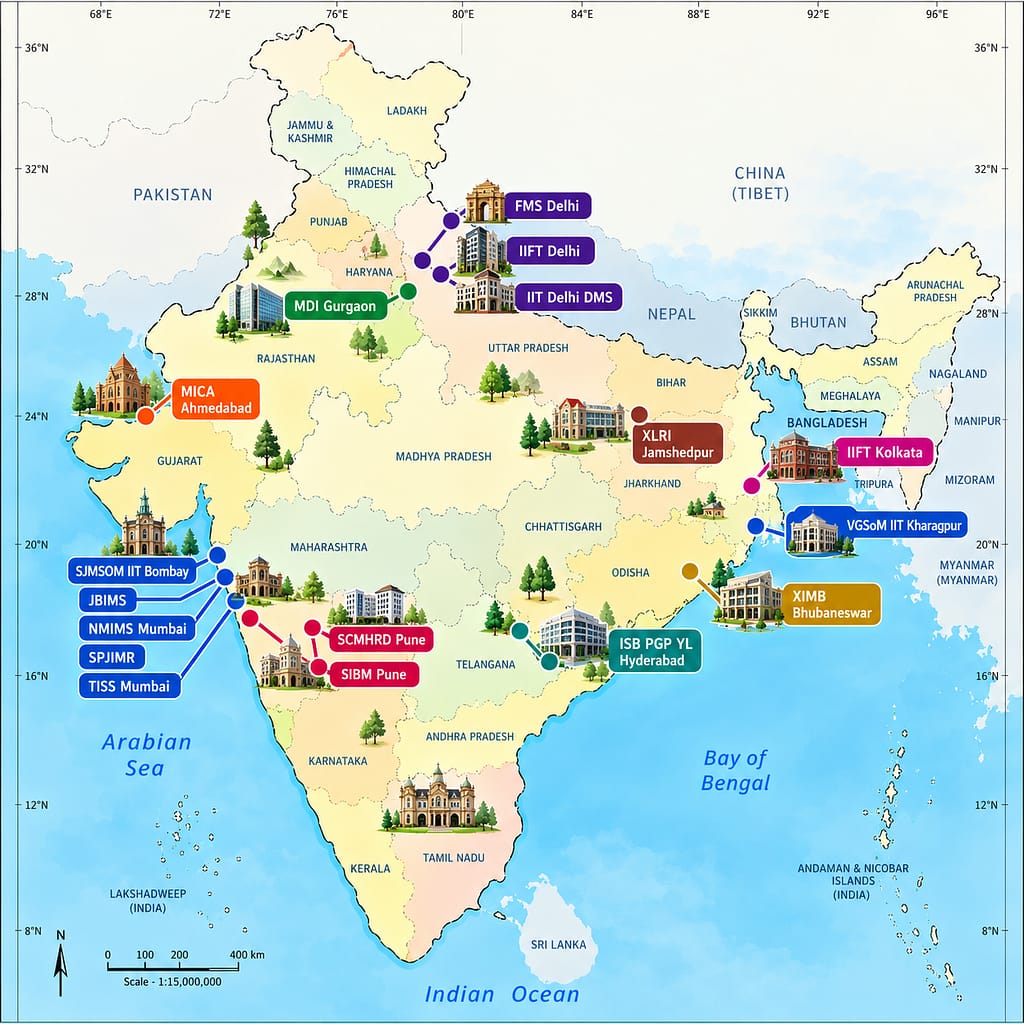
The schools in this comparison are concentrated in major education and business hubs. Delhi NCR includes FMS, IIFT Delhi, IIT Delhi DMS and MDI Gurgaon; Mumbai includes SJMSOM, JBIMS, NMIMS, SPJIMR and TISS; Pune includes SCMHRD and SIBM. The remaining locations include Ahmedabad, Hyderabad, Jamshedpur, Kolkata, Kharagpur and Bhubaneswar. Location can affect living costs, recruiter access, internships, travel and the kind of professional network you build. This geographic view adds a location dimension to the top non IIM MBA colleges in India comparison.
The geographic spread also creates distinct location choices. Delhi NCR offers access to FMS, IIFT Delhi, IIT Delhi DMS and MDI Gurgaon, while Mumbai has the largest cluster in this list with SJMSOM IIT Bombay, JBIMS, NMIMS, SPJIMR and TISS. Pune adds SCMHRD and SIBM, Ahmedabad is home to MICA, Hyderabad to ISB PGP YL, Jamshedpur to XLRI, Kolkata to IIFT Kolkata, Kharagpur to VGSoM IIT Kharagpur, and Bhubaneswar to XIMB. For applicants comparing otherwise similar options, these locations can influence housing and travel costs, proximity to particular industries, internship access and the professional ecosystem available during the programme.
Why This Is a Comparison Set, Not a Ranking
“Top 16” here means an editorial comparison set. It is not a league table. The schools are listed alphabetically, and the order says nothing about quality, selectivity or outcomes.
PREPON does not name a best school, a winner or a runner-up. A programme in HR, one in communications and one in general management serve different goals. The useful question is which programme fits your career goal, budget, profile and exam plan.
MBA, PGDM, MMS, MA and PGP YL: What the Qualification Names Mean
The headline says “MBA colleges” because that is how most students search. The qualifications themselves differ.
- MBA: the degree name at FMS, IIFT (MBA International Business), the three IIT programmes, NMIMS (MBA Core), XIMB (MBA-BM), and the Symbiosis programmes as reported.
- PGDM: a postgraduate diploma, as at MDI, MICA and SPJIMR.
- MMS: the Master of Management Studies at JBIMS.
- MA HRM & LR: TISS’s Master of Arts in Human Resources Management and Labour Relations. It is not an MBA.
- PGP YL: ISB’s Post Graduate Programme in Management for Young Leaders.
A name alone does not tell you about quality. The section on programme differences explains what to check instead.
How to Read This Comparison
Four Labels for Every Score
When comparing the top non IIM MBA colleges in India, admissions numbers are easy to misread. This guide uses four labels and never mixes them.
- Official minimum: a floor the institution publishes as an eligibility requirement.
- Official shortlist or closing data: a cutoff or closing figure published for a specific cycle.
- Indicative competitive range: an estimate, used only where defensible evidence exists.
- Insufficient reliable evidence: the default when a competitive range cannot be supported.
For most schools, the honest entry in the competitive-score column is “Insufficient reliable evidence for a defensible competitive range.” That is deliberate. An unsupported percentile can mislead a candidate more than a blank cell.
Average CTC, Median CTC and Report Scope
Average CTC (cost to company) is the mean across placed students. Median is the middle value. A few very high offers raise the average without changing the median. Neither number is the salary of a typical student.
Every figure below shows its cohort year and the scope of the report, such as programmes and campuses included. Do not compare figures from different years or scopes as if they were like for like.
What Changes Every Year
Entrance tests, cutoffs, weightages, fees, seat intake, batch size, placement figures and application dates all change from cycle to cycle. See the Annual Update Box near the end.
Master Comparison: Top Non Iim Mba Colleges In India at a Glance
Official cutoff ≠ competitive score. An official minimum only makes you eligible to be considered. It does not tell you what score usually leads to a shortlist.
Where an institute does not separately publish a figure in the current official material reviewed, this guide says so explicitly rather than substituting an estimate or a third-party number.
Table A: Admissions
| B-School | Programme | Exam(s) | Official Cutoff / Threshold | Indicative Competitive Score |
|---|---|---|---|---|
| FMS Delhi | MBA | CAT | No single universal minimum percentile is used here. Final selection weightages: CAT 50%, Class X 10%, Class XII 10%, SOP Discussion 10%, Extempore 5%, PI 15%; women-candidate weightage applies per official policy | Insufficient reliable evidence for a defensible competitive range |
| IIFT | MBA (International Business) | CAT, followed by the institute’s current selection process | The institute’s current notice should be used for category- and stage-specific shortlisting criteria; no single universal cutoff is presented here | Insufficient reliable evidence for a defensible competitive range |
| ISB | PGP YL | CAT, GMAT or GRE | No published minimum test score to apply (see profile). 2026–28 class average CAT percentile: 99.09 (class profile, not a cutoff) | Class profile only. Insufficient reliable evidence for a defensible competitive range |
| IIT Bombay SJMSOM | MBA | CAT (domestic) | Official PI shortlisting uses the institute’s published composite-score criteria for the relevant cycle; see the profile and current admission notice | Insufficient reliable evidence for a defensible competitive range |
| IIT Delhi DMS | MBA | CAT (domestic) | Official shortlisting uses the institute’s published CAT-based composite formula for the relevant cycle; check the current admission notice | Insufficient reliable evidence for a defensible competitive range |
| IIT Kharagpur VGSoM | MBA | CAT (see profile) | Restricted degree eligibility (see profile) | Insufficient reliable evidence for a defensible competitive range |
| JBIMS | MMS | Route-based via Maharashtra CAP | CAP-route based. No single universal cutoff (see profile) | Insufficient reliable evidence for a defensible figure |
| MDI Gurgaon | PGDM (and related two-year programmes) | CAT 2026 (domestic); GMAT only for the permitted PGDM-IB route | MDI publishes programme- and stage-specific admission criteria; use the current admission notice rather than a single third-party percentile | Insufficient reliable evidence for a defensible competitive range |
| MICA | PGDM-C | CAT, XAT or GMAT, plus MICAT (both required) | No single CAT/XAT/GMAT percentile alone determines admission: applicants must also take MICAT and proceed through MICA’s selection stages | Insufficient reliable evidence for a defensible competitive range |
| NMIMS Mumbai | MBA Core | NMAT by GMAC | NMAT-based shortlisting is cycle-specific; use NMIMS’s current admission handout for the applicable threshold and selection stages | Insufficient reliable evidence for a defensible competitive range |
| SPJIMR | PGDM; PGDM (BM) | CAT 2026 or GMAT (2027–29 admission) | Profile-based and profile-cum-score-based shortlisting applies; use SPJIMR’s current admission criteria rather than a single universal cutoff | Insufficient reliable evidence for a defensible competitive range |
| SCMHRD Pune | MBA | SNAP, then GE/PI | SNAP-based shortlisting followed by GE/PI; the applicable shortlist threshold is cycle-specific | Insufficient reliable evidence for a defensible competitive range |
| SIBM Pune | MBA | SNAP, then GE/PI | SNAP-based shortlisting followed by GE/PI; the applicable shortlist threshold is cycle-specific | Insufficient reliable evidence for a defensible competitive range |
| TISS Mumbai | MA HRM & LR | CAT | Gen/KM/AF/EWS: 60 sectional, 70 overall. NC-OBC: 54 / 63. SC/ST: 45 / 53 (official minimums) | Insufficient reliable evidence for a defensible competitive range |
| XIMB | MBA-BM | XAT, CAT, GMAT, XGMT (2027 admission) | Programme- and exam-specific shortlisting applies; use XIM University’s current MBA-BM admission notice | Insufficient reliable evidence for a defensible competitive range |
| XLRI | BM and HRM programmes | XAT (domestic) | XAT-based programme- and category-specific shortlisting applies; use XLRI’s current BM/HRM admission criteria | Insufficient reliable evidence for a defensible competitive range |
Table B: Costs and Outcomes
CTC figures are shown in INR lakh per annum (LPA). Each carries its cohort year and report scope.
| B-School | Fees (as published, with scope) | Average CTC | Median CTC | Batch / Cohort | Positioning |
|---|---|---|---|---|---|
| FMS Delhi | Approx. INR 60,818 per semester under the published fee structure; verify the current university notice | 32.27 LPA (2024–26) | 29.59 LPA (2024–26) | 307 (2024–26 batch) | General management, university-based |
| IIFT | MBA (IB) 2025–27: approx. INR 21.82 lakh Delhi; INR 21.32 lakh Kolkata | 31.3 LPA (MBA IB, 2023–25) | 26.0 LPA (MBA IB, 2023–25) | Campus/programme intake varies by the current admission cycle | International business and trade |
| ISB PGP YL | 2027–29 programme fee: approx. INR 25.60 lakh + GST for the specified shared-accommodation/single-instalment configuration | Not yet available for the new PGP YL cohort; do not substitute traditional ISB PGP placement data | Not applicable | 132 (2026–28 cohort) | Early-career leadership programme, 20 months |
| IIT Bombay SJMSOM | Approx. INR 15.558 lakh total, 2026–28, General/EWS/OBC-NCL | 25.82 LPA (2024–25) | 25.25 LPA (2024–25) | Use the current programme batch profile/admission notice; placement report scope should be checked separately | General management, IIT setting |
| IIT Delhi DMS | Approx. INR 12 lakh tuition, 2026–28 (tuition only) | Use the current official placement report for the MBA cohort; this guide does not substitute an unverified figure | Use the current official placement report for the MBA cohort; this guide does not substitute an unverified figure | Use the current admission/placement report for the applicable cohort | General management, IIT setting |
| IIT Kharagpur VGSoM | Use the current official MBA fee schedule; additional institute/hostel charges may apply | 22.75 LPA (2023–25) | 22.15 LPA (2023–25) | Use the current official placement report for the reported cohort | General management, IIT setting |
| JBIMS | Public/university fee structure; verify the current MMS fee notice and applicable category/candidature charges | Use the Unified Final Placement Report 2024–26 for the current official placement figures | Use the Unified Final Placement Report 2024–26 for the current official placement figures | Use the current MMS admission/placement report for the applicable cohort | University-affiliated management degree, Mumbai |
| MDI Gurgaon | Approx. INR 26,55,310 (PGDM/HRM/BA two-year, current published) | 29.5 LPA (PGDM, 2024–26) | 29 LPA (PGDM, 2024–26) | Programme-specific; verify the current placement report scope | General and specialised PGDM programmes |
| MICA | Approx. INR 29.50 lakh indicated (PGDM-C) | 19.50 LPA (PGDM-C/PGDM, 2022–24 official combined report) | 18.60 LPA (PGDM-C/PGDM, 2022–24 official combined report) | 180 seats | Strategic marketing and communications |
| NMIMS Mumbai | Use the current NMIMS Mumbai MBA fee schedule; fees are programme- and academic-year specific | 24.6 LPA (MBA Core, 2025–26) | Median CTC is not separately published in the current official material reviewed | Use the current MBA Core placement report for cohort scope | General management, Mumbai |
| SPJIMR | Approx. INR 24.86 lakh indicative programme fee for the relevant 2027–29 admission cycle | 33.75 LPA (2026, combined PGDM + PGDM (BM)) | 32.85 LPA (2026; combined PGDM + PGDM (BM)); programme-level median also 32.85 LPA | PGDM: 240 Indian-national seats + 36 foreign/OCI/PIO where applicable; PGDM (BM): 120 seats (2027–29) | General management plus a distinct BM programme |
| SCMHRD Pune | Use the current SCMHRD MBA fee schedule; academic and hostel charges should be checked separately | 21.47 LPA (2023–25) | 20 LPA (2023–25) | Use the current official placement report for cohort scope | Management with HR and other specialisations, Pune |
| SIBM Pune | Use the current SIBM Pune MBA fee schedule; academic and hostel charges should be checked separately | 28.18 LPA (2024–26) | 27 LPA (2024–26) | Use the current official placement report for cohort scope | Management with specialisations, Pune |
| TISS Mumbai | Approx. INR 2,03,500 (as displayed by TISS; scope to be confirmed) | 28.69 LPA (mean; 2024–26) | 28 LPA (2024–26) | 65 participants (2024–26) | HR and labour relations (MA) |
| XIMB | Approx. INR 11.50 lakh per academic year, before other published charges | Use the current official MBA-BM placement report; this guide does not substitute an unverified figure | Use the current official MBA-BM placement report; this guide does not substitute an unverified figure | Use the current MBA-BM admission/placement report for cohort scope | Business management, residential MBA |
| XLRI | Use the current XLRI BM/HRM fee schedule; programme and residential charges should be checked for the admission cycle | 31.40 LPA (2026; combined scope) | 29 LPA (2026; combined scope) | 576 students in the reported scope (2026) | Business management and HR |
Notes on scope:
- XLRI’s 2026 figures cover 576 students across the reported Jamshedpur and Delhi-NCR scope.
- SPJIMR’s 2026 average is a combined PGDM + PGDM (BM) figure.
- TISS’s report uses “mean,” which is the same as the average.
- IIFT’s figures are for MBA (IB), 2023–25.
Entrance Exams for the Top Non Iim Mba Colleges In India
Short answer: CAT opens the largest group of schools in this comparison, but no single exam covers all 16. XAT, SNAP, NMAT, MICAT and the Maharashtra route each unlock specific schools.
Exam-to-School Map
Confirm every row against the current-cycle notice. Rules change.
| Exam | Schools it serves in this set | Route-specific notes |
|---|---|---|
| CAT | FMS, ISB PGP YL, SJMSOM, DMS, VGSoM, MDI, MICA (with MICAT), SPJIMR, TISS MA HRM & LR, XIMB; also part of the JBIMS route where applicable | VGSoM has restricted degree eligibility. TISS has sectional minimums. JBIMS depends on the CAP route |
| XAT | XLRI (domestic BM/HRM), MICA (with MICAT), XIMB | MDI and SPJIMR are not XAT routes for the programmes described here |
| SNAP | SIBM Pune, SCMHRD Pune | Followed by GE/PI selection |
| NMAT by GMAC | NMIMS Mumbai (MBA Core) | Relevant to the core MBA route |
| MICAT | MICA | Mandatory in addition to CAT, XAT or GMAT |
| MAH MBA/MMS CET and Maharashtra route | JBIMS | Depends on candidature category and CAP |
| GMAT | ISB PGP YL, MICA, XIMB, SPJIMR, MDI (PGDM-IB route only) | Not a general MDI route |
| GRE | ISB PGP YL | |
| XGMT | XIMB | |
| IIFT’s current route | Not verified in this source set | Check IIFT’s official current-cycle notice |
Building an Exam Stack
CAT plus XAT plus SNAP plus NMAT does not keep all 16 schools open. MICA also requires MICAT, JBIMS depends on the Maharashtra route, and other schools have route-specific conditions. A layered plan is more accurate.
| Layer | Exams | Adds |
|---|---|---|
| Core | CAT | The broad core of the set |
| Wider coverage | CAT + XAT | XLRI, plus XAT routes at MICA and XIMB |
| Add SNAP | + SNAP | SIBM Pune and SCMHRD Pune |
| Add NMAT | + NMAT | NMIMS Mumbai (MBA Core) |
| Add MICAT | + MICAT | Completes the MICA testing route |
| Add the Maharashtra route | + MAH MBA/MMS CET where applicable | JBIMS route coverage, depending on candidature |
| Optional | GMAT or GRE | ISB PGP YL, plus the specifically permitted routes at MICA, XIMB, SPJIMR and MDI (PGDM-IB) |
Route-Specific Exceptions to Remember
- MICA: an accepted CAT, XAT or GMAT score alone does not complete the testing route. MICAT is also required.
- MDI: domestic applicants to the principal two-year programmes use CAT 2026. GMAT is an alternative only for the permitted PGDM-IB route, subject to the published condition for applicants applying only to that programme.
- TISS: meeting the overall percentile is not enough. Sectional minimums also apply.
- VGSoM: eligibility is restricted by degree background.
- IIFT: the current route must be read from IIFT’s official notice.
Registration windows and test dates often overlap. Check the official calendars early and plan around clashes.
Building your exam plan? Explore PREPON’s CAT preparation, XAT preparation, SNAP preparation and NMAT preparation resources.
Profiles: Top Non Iim Mba Colleges In India (Alphabetical)
Each profile follows the same structure. Where a figure was not found in official sources, the profile says so.
Faculty of Management Studies (FMS), University of Delhi
For current programme and eligibility details, verify the official FMS MBA Full-Time page before applying.
Programme: MBA at a university faculty.
Entrance exam: CAT.
Official cutoff / selection threshold: No single published minimum percentile was located in the source set. The published selection architecture for the relevant cycle is CAT 50%, Class X 10%, Class XII 10%, SOP Discussion 10%, Extempore 5% and Personal Interview 15%. FMS’s official policy also applies a women-candidate weightage. Check the current notice for its exact value.
Indicative competitive score: Insufficient reliable evidence for a defensible competitive range.
Fees: Approximately INR 60,818 per semester under the published fee structure. Verify the current University of Delhi/FMS notice because fee components can change.
Placements: According to the 2024–26 report, the average CTC is INR 32.27 LPA and the median is INR 29.59 LPA.
Batch size: 307 (2024–26 batch).
Selection process: Weighted composite of CAT, academics, SOP discussion, extempore and interview, as above.
Key strengths / career positioning: A general-management programme with a published, multi-component selection design and a public-university fee structure.
Trade-offs: Class X and XII scores carry formal weight, so academic history matters alongside CAT. The competitive range is not verified here.
Who should consider it: Candidates with a CAT score and a strong academic record who want general management and prefer a university setting.
Indian Institute of Foreign Trade (IIFT), New Delhi and Kolkata
Programme: MBA (International Business), abbreviated MBA (IB). This article keeps New Delhi and Kolkata as its comparison scope. IIFT’s MBA (IB) is also offered at additional locations, including GIFT City and Kakinada. Fees, intake, placements and admissions should not be assumed identical across campuses.
Entrance exam: Not verified in the source set used for this article. Read the current-cycle admission route from IIFT’s official notice.
Official cutoff / selection threshold: Use IIFT’s current admission notice for category- and stage-specific shortlisting criteria; this guide does not present a single universal percentile as an official cutoff.
Indicative competitive score: Insufficient reliable evidence for a defensible competitive range.
Fees: For MBA (IB) 2025–27, approximately INR 21.82 lakh at Delhi and INR 21.32 lakh at Kolkata. Verify the current campus-specific fee notice.
Placements: For MBA (IB), 2023–25, the average CTC is INR 31.3 LPA and the median is INR 26.0 LPA. Campus scope is not broken down in the source set.
Batch size: Intake is campus- and cycle-specific. Use the current IIFT admission notice rather than carrying forward an older cohort figure.
Selection process: Not verified for the current cycle.
Key strengths / career positioning: A programme oriented toward international trade and business, with a curriculum framed around that specialisation.
Trade-offs: The specialisation is narrower than general management. The gap between average and median CTC is notable, so read both figures.
Who should consider it: Candidates interested in international business, trade and global operations, after confirming the campus and current admission route.
Indian School of Business (ISB): PGP YL
Programme: Post Graduate Programme in Management for Young Leaders (PGP YL). It is a 20-month, full-time, residential programme aimed at candidates with roughly 0–2 years of work experience, including fresh graduates. It is a different programme from ISB’s traditional PGP.
Entrance exam: CAT, GMAT or GRE.
Official cutoff / selection threshold: ISB does not publish a minimum entrance-test score merely to apply, unlike institutions that publish eligibility thresholds. Admission evaluates the whole application.
Indicative competitive score: The 2026–28 class (132 students) has an average CAT percentile of 99.09, according to ISB’s July 2026 announcement. That is a class-profile statistic. It is not an official cutoff, an eligibility threshold, or a required percentile.
Fees: ISB publishes an official PGP YL fee schedule. The exact figure was not confirmed in this source set, so check ISB’s current fee page.
Placements: Do not use traditional ISB PGP placement statistics as PGP YL outcomes. PGP YL is a newer programme and a mature graduating-cohort final-placement report is not yet available for comparison.
Batch size: 132 (2026–28 cohort).
Important: Placement caveat: Placement figures for ISB’s traditional PGP are not PGP YL outcomes. As of September 2026, no graduating-class final-placement report specific to PGP YL was located. Until one applies, compare PGP YL on cohort profile, curriculum, fees and ISB’s published programme information rather than salary.
Selection process: Consult ISB’s official application pages for the current stages.
Key strengths / career positioning: An early-career route into a residential management programme, with a shorter duration than a conventional two-year programme.
Trade-offs: No programme-specific placement history to evaluate, so the programme’s maturity is a factor. The class profile shows a high average test percentile, which is context and not a threshold.
Who should consider it: Fresh graduates and early-career candidates who want a 20-month residential programme and are comfortable making a decision without mature placement data.
IIT Bombay: Shailesh J. Mehta School of Management (SJMSOM)
Programme: Master of Business Administration (MBA).
Entrance exam: CAT for domestic admission.
Official cutoff / selection threshold: The institute uses official PI and composite selection criteria. These should be kept distinct from informal competitive-percentile estimates found online. The current criteria were not reproduced in the source set, so check the admission notice.
Indicative competitive score: Insufficient reliable evidence for a defensible competitive range.
Fees: Approximately INR 15.558 lakh total programme fee for 2026–28 for the applicable General/EWS/OBC-NCL category. Category distinctions apply. Check the current fee notice for other categories.
Placements: For 2024–25, the average CTC is INR 25.82 LPA and the median is INR 25.25 LPA.
Batch size: Use the current SJMSOM admission or placement report for the applicable cohort; the placement figures above should not be used to infer intake.
Selection process: CAT-based shortlisting followed by the institute’s composite process.
Key strengths / career positioning: A general-management programme in an IIT setting with a published total fee.
Trade-offs: Selection is CAT-dependent. Verify the current cohort size separately when comparing classroom scale and recruiter access.
Who should consider it: Candidates with a CAT score seeking a technology-institute setting and general management.
IIT Delhi: Department of Management Studies (DMS)
Programme: MBA.
Entrance exam: CAT for domestic admission.
Official cutoff / selection threshold: IIT Delhi DMS uses its published CAT-based shortlisting formula for the relevant cycle. Use the current admission notice for category-specific thresholds and weightages.
Indicative competitive score: Insufficient reliable evidence for a defensible competitive range.
Fees: Approximately INR 12 lakh tuition for the full MBA programme (2026–28). This is tuition only; residential and living costs are additional and vary by accommodation and personal spending.
Placements: Use the current official DMS IIT Delhi MBA placement report for cohort-specific average, median and report scope; this guide does not substitute an unverified figure.
Batch size: Use the current DMS admission or placement report for the applicable cohort.
Selection process: Check the current DMS admission notice.
Key strengths / career positioning: A general-management programme within an IIT department.
Trade-offs: Tuition is not total cost. Compare the current official placement report and cohort scope before making an outcome comparison.
Who should consider it: Candidates who want an IIT-affiliated MBA and are willing to check placement and residential-cost information directly.
IIT Kharagpur: Vinod Gupta School of Management (VGSoM)
Programme: MBA.
Entrance exam: CAT (check the current notice for the route).
Official cutoff / selection threshold: Eligibility is restricted by degree background. It is not open to every graduate. The institute’s stated requirements include specified engineering, technology and pharmacy degrees, and qualifying master’s degrees in Science, Economics or Commerce, subject to the institute’s mathematical or statistical conditions. Read the exact current wording in the admission notice before applying.
Indicative competitive score: Insufficient reliable evidence for a defensible competitive range.
Fees: Use VGSoM’s current official MBA fee schedule. Institute, hostel and other charges should be checked separately for the applicable admission cycle.
Placements: For 2023–25, the average CTC is INR 22.75 LPA and the median is INR 22.15 LPA.
Batch size: Use the current VGSoM admission or placement report for the applicable cohort.
Selection process: Check the current institute notice.
Key strengths / career positioning: A general-management programme with a defined eligibility profile.
Trade-offs: Restricted eligibility rules out many applicants. The placement figures are from an earlier cohort than some other schools’ figures.
Who should consider it: Candidates whose degree background meets the published eligibility rules and who want an IIT-linked MBA.
Jamnalal Bajaj Institute of Management Studies (JBIMS), Mumbai
Programme: Master of Management Studies (MMS), a university-affiliated management degree. It is not an autonomous PGDM.
Entrance exam: Route-based, through Maharashtra’s Centralised Admission Process (CAP). It is not accurate to summarise JBIMS as “MAH CET, CAT and GMAT accepted.”
How JBIMS admission works (CAP explained)
- CAP: Admission to MMS seats in Maharashtra runs through a state centralised admission process, administered by the State CET Cell. Check the current cycle’s process, timeline and information brochure.
- Candidature categories: Applicants are classified into categories, such as Maharashtra State candidature and All India or other applicable candidature. Category definitions and eligibility conditions are set out in the CET Cell’s brochure.
- Route-specific exams: In general, Maharashtra-route seats consider MAH MBA/MMS CET scores, while other applicable routes consider national test scores such as CAT. The exact combinations, and whether other tests are allowed for a given route, must be read from the current brochure.
- Seat categories: Seats are divided by category and reservation. Which seat category you fall in depends on domicile and reservation status. The current seat matrix was not verified for this draft.
- Domicile and category: Domicile, category certificates and other documents affect which seats you can compete for.
- CAP merit behaviour: Closing percentiles are outcomes of a particular cycle, category and round. They describe where a seat list closed. They are not eligibility rules.
Official eligibility vs CAP closing behaviour:
| Question | Official eligibility | CAP closing percentile / merit behaviour |
|---|---|---|
| What is it? | The conditions that let you apply through a route | Where merit lists closed for a category in a round |
| Who sets it? | The CET Cell and the institute | The applicant pool and available seats |
| Does it change? | By rule change | Every cycle, category and round |
| Can it be a single number? | Not for all candidates | No |
The very high MAH MBA/MMS CET percentile commonly associated with JBIMS is a closing or merit outcome for particular categories and cycles. It is not one universal institutional cutoff for every candidate. Any figure you see should state the exam, cycle, category, round and source. Without those, treat it as unreliable.
Indicative competitive score: Insufficient reliable evidence for a defensible figure.
Fees: JBIMS follows a public/university fee structure. Verify the current MMS fee notice and any candidature- or category-specific charges rather than using an older fee figure.
Placements: JBIMS publishes a Unified Final Placement Report for 2024–26. Use that report for the current average, median and cohort scope rather than a third-party summary.
Batch size: Current seat matrix or intake not verified.
Key strengths / career positioning: A Mumbai-based MMS programme with admission through a state centralised process.
Trade-offs: The admission architecture is more complex than a single test. Category and domicile matter.
Who should consider it: Candidates who understand the CAP route and category rules, and who are prepared to take the exam or exams the relevant route requires.
Management Development Institute (MDI), Gurgaon
Programme: PGDM and related two-year programmes, including HRM, BA and IB variants.
Entrance exam: For 2027–29 admissions, domestic applicants to the principal two-year programmes use CAT 2026. GMAT is an alternative only for the specifically permitted PGDM-IB application route, including the published condition for candidates applying exclusively to that programme. MDI is not a broad XAT route.
Official cutoff / selection threshold: MDI publishes programme- and stage-specific admission criteria. Use the current admission notice rather than treating a single third-party CAT percentile as an official cutoff.
Indicative competitive score: Insufficient reliable evidence for a defensible competitive range.
Fees: Approximately INR 26,55,310 for the current published PGDM, HRM and BA two-year programmes. The PGDM-IB fee should be checked separately.
Placements: For PGDM 2024–26, the reported average CTC is approximately INR 29.5 LPA and the median is INR 29 LPA. Programme scope matters because HRM and other programmes report separately.
Batch size: Programme-specific. Verify the current admission and placement report for the programme you are comparing.
Selection process: Consult MDI’s admission notice.
Key strengths / career positioning: A set of PGDM programmes with distinct specialisations.
Trade-offs: The GMAT route is narrow and applies only to the permitted PGDM-IB route. Placement outcomes are programme-specific, so compare the report for the exact programme.
Who should consider it: Candidates with a CAT 2026 score who are comparing PGDM specialisations.
MICA, Ahmedabad
Programme: PGDM-C, a specialised programme in strategic marketing and communications. It is not a conventional general-management MBA.
Entrance exam: CAT, XAT or GMAT, plus MICAT. MICAT is mandatory. A CAT, XAT or GMAT score alone does not complete the MICA testing route.
Official cutoff / selection threshold: MICA does not reduce admission to one CAT/XAT/GMAT cutoff. Applicants must also take MICAT and proceed through MICA’s programme-specific selection process.
Indicative competitive score: Insufficient reliable evidence for a defensible competitive range.
Fees: Approximately INR 29.50 lakh indicated for the PGDM-C. Check what the figure includes.
Placements: The official 2022–24 combined placement report shows approximately INR 19.50 LPA average CTC and INR 18.60 LPA median CTC. Treat the cohort year and combined report scope explicitly.
Batch size: 180 seats.
Selection process: Check MICA’s current admission notice.
Key strengths / career positioning: Focused positioning around marketing, brand and communications.
Trade-offs: The specialisation is narrower than general management. It carries a higher published fee and an additional mandatory test.
Who should consider it: Candidates set on marketing and communications careers who will sit MICAT.
Narsee Monjee Institute of Management Studies (NMIMS), Mumbai
Programme: MBA Core. NMIMS offers other programmes too. The placement figure below refers to MBA Core only.
Entrance exam: NMAT by GMAC for the core MBA route.
Official cutoff / selection threshold: NMIMS uses NMAT-based shortlisting and a cycle-specific selection process. Use the current NMIMS admission handout for the applicable threshold and stages.
Indicative competitive score: Insufficient reliable evidence for a defensible competitive range.
Fees: Use the current NMIMS Mumbai MBA Core fee schedule. Fees are programme- and academic-year specific and should not be inferred from another NMIMS programme.
Placements: For MBA Core, 2025–26, the average CTC is INR 24.6 LPA. Median CTC is not separately published in the current official material reviewed.
Batch size: Use the current MBA Core placement or admission report for cohort scope.
Selection process: Check the current NMIMS notice.
Key strengths / career positioning: A Mumbai-based general-management programme with its own entrance route.
Trade-offs: Requires NMAT, which is not needed by most other schools in this set. No median is available here.
Who should consider it: Candidates who plan to take NMAT and want a Mumbai programme.
S. P. Jain Institute of Management & Research (SPJIMR), Mumbai
Programme: PGDM, and a separate PGDM (BM). The two should not be treated as one programme.
Entrance exam: For 2027–29, CAT 2026 or GMAT. XAT is not an accepted route.
Official cutoff / selection threshold: SPJIMR uses profile-based and profile-cum-score-based shortlisting. Use the current admission criteria rather than treating one percentile as a universal official cutoff.
Indicative competitive score: Insufficient reliable evidence for a defensible competitive range.
Fees: Approximately INR 24.86 lakh indicative programme fee for the relevant 2027–29 admission cycle. Verify inclusions and residential charges in the current fee schedule.
Placements: For 2026, the combined PGDM + PGDM (BM) average CTC is INR 33.75 LPA. Median CTC: not separately published in the current official material reviewed.
Batch size: For 2027–29, PGDM has 240 seats for Indian nationals, plus 36 seats for foreign nationals, OCI and PIO applicants where applicable under the published policy. PGDM (BM) has 120 seats.
Selection process: Check SPJIMR’s current admission notice.
Key strengths / career positioning: A flagship PGDM alongside a distinct BM programme, so the intake and outcomes should be read by programme.
Trade-offs: The combined placement report blends two programmes.
Who should consider it: Candidates with CAT 2026 or GMAT scores who want to compare PGDM and PGDM (BM).
Symbiosis Centre for Management and Human Resource Development (SCMHRD), Pune
Programme: MBA.
Entrance exam: SNAP, followed by the applicable GE and PI selection process.
Official cutoff / selection threshold: SCMHRD shortlists through SNAP and then GE/PI. The applicable shortlist threshold is cycle-specific and should be checked in the current admission notice.
Indicative competitive score: Insufficient reliable evidence for a defensible competitive range.
Fees: Use the current SCMHRD MBA fee schedule and check academic, institute and hostel charges separately.
Placements: For 2023–25, the average CTC is INR 21.47 LPA and the median is INR 20 LPA.
Batch size: Use the current SCMHRD placement or admission report for cohort scope.
Selection process: SNAP score, then GE and PI.
Key strengths / career positioning: A Pune-based programme with a SNAP-based route.
Trade-offs: Placement figures are from 2023–25, earlier than some others in this set.
Who should consider it: Candidates planning SNAP who are comparing Pune programmes.
Symbiosis Institute of Business Management (SIBM), Pune
Programme: MBA.
Entrance exam: SNAP, followed by the applicable GE and PI stages.
Official cutoff / selection threshold: SIBM Pune shortlists through SNAP and then GE/PI. The applicable shortlist threshold is cycle-specific and should be checked in the current admission notice.
Indicative competitive score: Insufficient reliable evidence for a defensible competitive range.
Fees: Use the current SIBM Pune MBA fee schedule and check academic, institute and hostel charges separately.
Placements: For 2024–26, the average CTC is INR 28.18 LPA and the median is INR 27 LPA.
Batch size: Use the current SIBM Pune placement or admission report for cohort scope.
Selection process: SNAP score, then GE and PI.
Key strengths / career positioning: A Pune-based programme with a SNAP-based route.
Trade-offs: Cohort years differ from SCMHRD’s figures, so do not compare them directly.
Who should consider it: Candidates planning SNAP who want to compare across the Pune Symbiosis programmes.
Tata Institute of Social Sciences (TISS), Mumbai
Programme: Master of Arts in Human Resources Management and Labour Relations (MA HRM & LR). It is an MA, not an MBA.
Entrance exam: CAT.
Official cutoff / selection threshold: TISS publishes CAT minimums, which apply to the sectional and overall percentiles:
| Category | Each CAT section | Overall |
|---|---|---|
| General / KM / AF / EWS | 60 percentile | 70 percentile |
| NC-OBC | 54 | 63 |
| SC / ST | 45 | 53 |
These are official minimums. They do not describe competitive likelihood, and meeting them does not guarantee shortlisting or an interview.
For HRM & LR Online Assessment shortlisting, the weightage is CAT 97% and gender diversity 3%. Final merit is CAT 70% and Online Interview 30%.
Indicative competitive score: Insufficient reliable evidence for a defensible competitive range.
Fees: TISS displays a course fee of approximately INR 2,03,500. Confirm what period and items it covers, and check hostel and other charges separately. TISS is a public institute, so its cost structure differs from private programmes.
Placements: For 2024–26, 65 participants, mean CTC INR 28.69 LPA, and median CTC INR 28 LPA.
Batch size: 65 participants (2024–26).
Selection process: CAT minimums, Online Assessment shortlisting, then Online Interview.
Key strengths / career positioning: A specialised programme in HR and labour relations.
Trade-offs: The cohort is small, so figures reflect a small group. The programme is not an MBA.
Who should consider it: Candidates set on HR and labour relations who can meet the sectional minimums.
Xavier Institute of Management, XIM University (XIMB), Bhubaneswar
Programme: MBA-BM, a two-year, fully residential MBA. It is not a PGDM-BM.
Entrance exam: For 2027 admission, XAT, CAT, GMAT or XGMT.
Official cutoff / selection threshold: XIMB uses programme- and exam-specific shortlisting for MBA-BM. Use XIM University’s current admission notice for the applicable XAT, CAT, GMAT or XGMT route.
Indicative competitive score: Insufficient reliable evidence for a defensible competitive range.
Fees: Approximately INR 11.50 lakh in each academic year, before additional published charges. That is the academic fee, not the total programme cost.
Placements: Use the current official XIMB MBA-BM placement report for average, median and cohort scope; this guide does not substitute an unverified figure.
Batch size: Use the current MBA-BM admission or placement report for the applicable cohort.
Selection process: Check the current XIMB notice.
Key strengths / career positioning: A residential MBA with several accepted tests.
Trade-offs: The published academic fee excludes additional charges, so total cost needs its own check. Compare current official MBA-BM placement data before making an outcome comparison.
Who should consider it: Candidates with an XAT, CAT, GMAT or XGMT score who want a residential business-management programme.
XLRI, Xavier School of Management, Jamshedpur
Programme: BM (Business Management) and HRM (Human Resource Management) are distinct programmes. Confirm each programme’s current naming and qualification in the official brochure.
Entrance exam: XAT for the domestic BM and HRM route. XLRI does not admit through CAT.
Official cutoff / selection threshold: XLRI uses XAT-based programme- and category-specific shortlisting for domestic BM and HRM applicants. Use the current admission criteria for the applicable thresholds.
Indicative competitive score: Insufficient reliable evidence for a defensible competitive range.
Fees: Use the current XLRI BM/HRM fee schedule. Programme, residential and other charges should be checked for the applicable admission cycle.
Placements: For 2026, the report covers 576 students across the reported Jamshedpur and Delhi-NCR scope, with average CTC INR 31.40 LPA and median CTC INR 29 LPA. These are combined figures. Whether BM and HRM are reported separately was not verified.
Batch size: 576 students in the reported 2026 placement scope.
Selection process: Check XLRI’s current admission notice.
Key strengths / career positioning: Two related programmes, one for general business management and one for HR.
Trade-offs: The combined placement scope makes it harder to isolate BM from HRM outcomes.
Who should consider it: Candidates sitting XAT who are choosing between BM and HRM.
Programme Differences Across the Top Non Iim Mba Colleges In India
XLRI BM vs XLRI HRM
BM is oriented to general business management. HRM is oriented to people management. The variables that change your decision are your career goal, the recruiter mix you are targeting, and whether you want a specialised or general profile.
The 2026 figures are combined, so do not assume they describe either programme alone. Ask XLRI for programme-level data.
XLRI HRM vs TISS HRM & LR
Both are HR-oriented, but they differ in qualification (a management programme vs an MA), entrance route (XAT vs CAT), fee structure, batch size (TISS’s 2024–26 cohort was 65 participants) and admission rules. TISS applies published sectional CAT minimums.
The variables to weigh are the exam you will sit, the qualification you want, cost, and the career route you have in mind.
MICA vs a Conventional General-Management MBA
MICA is a specialised programme in marketing and communications. Its testing route requires MICAT in addition to CAT, XAT or GMAT. The indicated fee is approximately INR 29.50 lakh, with 180 seats.
If you want general management, a broader programme may fit better. If you want marketing and communications specifically, MICA’s focus may matter more. The variables are specialisation, fee and the extra test.
IIFT MBA (IB) vs a General MBA
IIFT’s MBA (IB) is oriented to international business and trade. A general MBA covers a wider range of functions. IIFT also offers the programme at more than one location, so check the campus you would attend.
The variables are how important international business is to your goals, the campus, and the current admission route.
SJMSOM vs DMS IIT Delhi vs VGSoM
All three are IIT-linked MBA programmes. Published costs differ in scope: SJMSOM’s INR 15.558 lakh is a total programme fee (2026–28, General/EWS/OBC-NCL), while DMS’s roughly INR 12 lakh is tuition only. VGSoM restricts eligibility by degree background.
Placement figures come from different years: 2024–25 for SJMSOM and 2023–25 for VGSoM, and none was located for DMS. Compare with care.
SIBM Pune vs SCMHRD
Both use SNAP followed by GE and PI. SIBM’s figures are from 2024–26 and SCMHRD’s are from 2023–25, so they are not directly comparable. Compare the specialisations you want, the cohort years, and fees once verified.
ISB PGP YL vs a Conventional Two-Year MBA/PGDM
PGP YL is a 20-month residential programme for candidates with about 0–2 years of experience. Conventional programmes typically run two years. PGP YL does not yet have a located graduating placement report, so you cannot judge it on placement figures the way you can others.
The variables are duration, programme maturity, data availability and cost.
ISB PGP YL vs Traditional ISB PGP
The two are different programmes. PGP YL targets early-career candidates, and traditional PGP is designed for candidates with more work experience. Do not import the traditional PGP’s placement statistics into PGP YL.
SPJIMR: PGDM vs PGDM (BM)
For 2027–29, PGDM has 240 seats for Indian nationals plus 36 for foreign nationals, OCI and PIO applicants where applicable. PGDM (BM) has 120 seats. The 2026 placement average (INR 33.75 LPA) combines the two, so read it as a blended figure.
MDI Programme Distinctions
MDI runs PGDM and related two-year programmes (HRM, BA, IB). The GMAT route is limited to PGDM-IB under the published condition. The published fee of about INR 26,55,310 applies to the PGDM, HRM and BA programmes, so verify PGDM-IB separately.
NMIMS Programme Distinctions
NMIMS offers several programmes. The 2025–26 average of INR 24.6 LPA refers to MBA Core. Do not apply it to other NMIMS programmes.
JBIMS MMS vs a Conventional MBA/PGDM
JBIMS awards an MMS, a university-affiliated degree, and admits through Maharashtra’s CAP. Autonomous PGDM programmes usually run their own selection. The variables are the admission route, domicile and category, and how much a degree’s name matters for your goals.
MBA vs PGDM vs MA vs PGP YL: Does the Name Matter?
The name alone does not measure quality. Check the programme’s approvals and recognition, its curriculum, its outcomes and its cost. If you need a degree specifically for further study or regulated roles, confirm equivalence with the relevant authority.
Fees and ROI Across the Top Non Iim Mba Colleges In India
For the top non IIM MBA colleges in India, there is no reliable way to turn average CTC divided by fee into a return on investment. A fee ratio ignores most of what matters. This guide therefore does not compute one, and it does not name a universal best ROI.
Cost Components
- Tuition: the core academic fee.
- Mandatory charges: other fees the institute requires.
- Hostel and living costs: often separate, especially for residential programmes.
- Total programme cost: the sum of all of the above.
- Opportunity cost: salary you give up while studying.
- Duration: a 20-month programme and a 24-month programme have different opportunity costs.
- Debt burden: what you borrow and can comfortably repay.
Outcome Components
- Average CTC: the mean, which is pulled up by high offers.
- Median CTC: the middle value, less affected by extremes.
- CTC composition: fixed pay, variable pay, bonuses and other components can differ.
- Report scope: which programmes, campuses and cohorts a report covers.
The highest CTC is not a typical salary, and neither is the average for most students.
Fees Published for This Set
| B-School | Published fee (as stated) | What it covers | What to check |
|---|---|---|---|
| SJMSOM | Approx. INR 15.558 lakh (2026–28) | Total programme fee for General/EWS/OBC-NCL | Other categories |
| DMS | Approx. INR 12 lakh (2026–28) | Tuition | Residential and living costs |
| MDI | Approx. INR 26,55,310 | PGDM/HRM/BA two-year | PGDM-IB fee |
| MICA | Approx. INR 29.50 lakh | PGDM-C indicated fee | Inclusions |
| TISS | Approx. INR 2,03,500 | Course fee as displayed | Period covered, hostel |
| XIMB | Approx. INR 11.50 lakh per academic year | Academic fee | Additional published charges |
| Other schools | Use each institute’s current official fee schedule | Programme-specific published charges | Tuition, hostel, deposits and other mandatory charges |
Public and Subsidised Programmes
FMS, TISS and JBIMS may have materially different cost structures from private programmes. That reflects how they are funded. It is not evidence about programme quality, and a lower fee does not mean a weaker programme.
ISB PGP YL and ROI
PGP YL does not yet have a located graduating placement report. Do not extrapolate traditional PGP salaries, and do not compute a return from unrelated data.
How Should You Choose Among the Top Non Iim Mba Colleges In India?
For the top non IIM MBA colleges in India, this framework does not score or rank schools. It helps you decide which variables matter most for you.
Goals
Consider your career goal, whether you want a specialisation or general management, the programme structure and the qualification.
Outcomes
Look at the placement profile, median CTC, average CTC, recruiter ecosystem, internships and alumni ecosystem. Always check the cohort year and report scope.
Money
Look at fees, total programme cost, debt tolerance, opportunity cost and duration.
Context
Consider batch size, location, campus structure and programme maturity.
Feasibility
Consider whether you can meet the eligibility rules, your entrance-exam strategy, your profile and your work experience.
Decision Checklist
- What role or sector do I want after the programme?
- Do I want a specialisation or general management?
- Which qualification do I need: MBA, PGDM, MMS, MA or PGP YL?
- Which exams can I realistically sit?
- Do I meet the eligibility rules, including degree and sectional conditions?
- What is the total cost, including living costs?
- How much debt am I comfortable with?
- Which placement reports cover the programme I want, and what is their scope?
- Does location matter for my goals?
- How mature is the programme, and is outcome data available?
| If this describes you | Programmes to look at | Variables that changed |
|---|---|---|
| Set on HR | XLRI HRM, TISS HRM & LR, SCMHRD, MDI HRM | Exam (XAT, CAT, SNAP), qualification, fee |
| Set on marketing and communications | MICA | Mandatory MICAT, specialisation |
| Interested in international business | IIFT MBA (IB), MDI PGDM-IB | Campus, current route |
| Want general management with a CAT score | FMS, SJMSOM, DMS, VGSoM, SPJIMR, MDI, XIMB | Fee, eligibility, cohort data |
| Early-career and want a shorter residential programme | ISB PGP YL | Programme maturity, no placement report yet |
| Planning SNAP | SIBM Pune, SCMHRD | Cohort years, specialisations |
| Planning NMAT | NMIMS Mumbai | Programme scope |
| Understand Maharashtra’s CAP | JBIMS | Candidature, category, route |
Not sure which schools fit your profile? Speak with PREPON for B-school selection guidance. B-school selection guidance
Decision Scenarios for the Top Non Iim Mba Colleges In India (No Universal Winners)
1. FMS vs a Higher-Fee Private Programme
The situation: you have an offer or a realistic chance at both. Variables that change the decision are fee and debt, FMS’s weighted selection design, batch size, location and the recruiter ecosystem you want. Verify current fees and each report’s scope. Ask which variable matters most for you.
2. XLRI BM vs XLRI HRM
The situation: you sit XAT and are choosing a programme. Variables are your career goal, recruiter mix and how much you want to specialise. Verify whether programme-level placement data exists, since the combined 2026 report does not separate them.
3. XLRI HRM vs TISS HRM & LR
The situation: you want an HR career. Variables include exam (XAT vs CAT), qualification (management programme vs MA), sectional CAT minimums at TISS, fee structure and batch size. Verify current fees and selection rules.
4. SIBM Pune vs SCMHRD
The situation: you have a SNAP score and are choosing between Pune programmes. Variables are specialisation, cohort year of the placement report (2024–26 vs 2023–25) and fee. Verify current figures.
5. MICA vs a General MBA
The situation: you like marketing but are unsure about specialising. Variables are how certain you are about marketing and communications, the fee, and the mandatory MICAT. Verify seat numbers and outcomes.
6. SJMSOM vs DMS vs VGSoM
The situation: you are comparing IIT-linked MBAs. Variables include VGSoM’s restricted eligibility, the difference between SJMSOM’s total fee and DMS’s tuition-only figure, and different placement years. Verify residential costs and current data.
7. JBIMS vs FMS
The situation: you are comparing two publicly linked programmes. Variables are the admission architecture (Maharashtra CAP vs CAT-weighted selection), domicile and category, and the degree (MMS vs MBA). Verify current seat matrix and route rules.
8. SPJIMR vs Other General-Management Programmes
The situation: you have CAT 2026 or GMAT scores. Variables include PGDM vs PGDM (BM), the blended 2026 report, and fees. Verify the median, which was not officially verified here.
9. ISB PGP YL vs a Conventional Two-Year MBA/PGDM
The situation: you are early in your career. Variables are duration (20 months), programme maturity, test options (CAT, GMAT, GRE) and the lack of a located PGP YL placement report. Verify ISB’s current fee schedule.
10. ISB PGP YL vs FMS, SPJIMR or XLRI-Type Choices
The situation: you have several offers. Variables include available outcome data, cost and duration, and exam routes. Do not use traditional PGP placement figures for PGP YL. Verify each programme’s current data.
Preparing for GE, WAT and PI? See PREPON’s final-selection preparation. MBA final-selection preparation
Common Myths About the Top Non Iim Mba Colleges In India
Myth: an official minimum cutoff guarantees an interview. Reality: a minimum only makes you eligible. Shortlisting depends on the institute’s process. Check the selection weightages.
Myth: the highest CTC is a typical salary. Reality: it is an outlier. Look at the median and the report scope.
Myth: average CTC is what most students earn. Reality: the mean is lifted by high offers. Compare it with the median.
Myth: a low fee means a weaker programme. Reality: fees reflect funding and structure. FMS, TISS and JBIMS have different cost structures from private programmes.
Myth: MBA, PGDM, MA or PGP name alone determines quality. Reality: check recognition, curriculum, outcomes and cost.
Myth: CAT alone keeps every option in this set open. Reality: XLRI uses XAT, SIBM and SCMHRD use SNAP, NMIMS uses NMAT, MICA also requires MICAT, and JBIMS depends on the Maharashtra route.
Myth: an overall percentile is enough when sectional requirements exist. Reality: TISS, for example, applies both sectional and overall minimums.
Myth: JBIMS has one universal cutoff for every candidate. Reality: closing percentiles vary by exam, cycle, category and round.
Myth: ISB PGP placement figures apply to PGP YL. Reality: they are different programmes.
Myth: “Top 16” means a ranking. Reality: the 16 are an alphabetical comparison set.
Annual Update Box: What Changes Every Cycle
The following change from year to year. Treat every figure as tied to its stated cycle or cohort.
- Entrance-test rules and eligibility
- Official cutoffs and minimums
- Selection weightages
- Fees
- Seat intake
- Batch size
- Placement figures
- Application dates and registration windows
- Programme names and structures
Last verified: September 2026. PREPON reviews this article after each placement season and admission cycle.
Frequently Asked Questions About the Top Non Iim Mba Colleges In India
Which are the top non-IIM MBA colleges in India?
This guide compares 16 non-IIM programmes, listed alphabetically and not ranked. They include FMS, IIFT, ISB PGP YL, three IIT programmes, JBIMS, MDI, MICA, NMIMS, SPJIMR, SCMHRD, SIBM, TISS, XIMB and XLRI. Which suits you depends on your goals, budget and exams.
Is this list a ranking?
No. The 16 are an editorial comparison set in alphabetical order. The order does not reflect quality, selectivity or outcomes.
Which non-IIM B-schools accept CAT scores?
In this set, CAT is used at FMS, ISB PGP YL, SJMSOM, DMS, VGSoM, MDI, MICA (with MICAT), SPJIMR, TISS and XIMB, and in part of the JBIMS route where applicable. IIFT's current route should be read from its notice.
Which entrance exams keep the most schools open?
CAT is the broad core. Adding XAT extends coverage to XLRI. SNAP adds SIBM and SCMHRD, NMAT adds NMIMS, MICAT completes MICA's route, and the Maharashtra route covers JBIMS. No single exam covers all 16.
Does XLRI accept CAT?
For domestic BM and HRM admission, XAT is the relevant route. XLRI should not be treated as a CAT-admission school. Confirm the current notice.
What is the difference between XLRI BM and XLRI HRM?
BM is oriented to general business management and HRM to people management. The 2026 placement figures (average INR 31.40 LPA, median INR 29 LPA) cover 576 students in a combined scope, so they do not describe either programme separately.
What CAT percentile is required for FMS Delhi?
No single published minimum percentile was located. FMS uses a weighted process: CAT 50%, Class X 10%, Class XII 10%, SOP Discussion 10%, Extempore 5% and Personal Interview 15%. A competitive range cannot be defended from the evidence used here.
How does FMS Delhi select candidates?
Using the weightages above, plus an applicable women-candidate weightage under its official policy. Check the current notice for the exact value.
Does TISS accept CAT for HRM & LR?
Yes. TISS uses CAT for its MA in Human Resources Management and Labour Relations.
What are TISS's CAT cutoffs by category?
General, KM, AF and EWS candidates need 60 percentile in each section and 70 overall. NC-OBC needs 54 and 63. SC and ST need 45 and 53. These are official minimums, not competitive scores.
Is TISS MA HRM & LR the same as an MBA?
No. It is a Master of Arts. Its focus is HR and labour relations, and it should be evaluated as a different qualification.
Can fresh graduates join ISB?
ISB's PGP YL is designed for candidates with roughly 0–2 years of work experience and includes fresh graduates. Check ISB's official eligibility page for current conditions.
Which exams does ISB PGP YL accept?
CAT, GMAT and GRE.
Is a 95 percentile required for ISB?
No such official minimum was located. The 2026–28 class average CAT percentile was 99.09. That describes the incoming class and is not a cutoff or requirement.
Are ISB PGP placement figures the same as PGP YL placements?
No. They are different programmes. As of September 2026, no graduating PGP YL final-placement report was located.
Does MICA require MICAT?
Yes. MICA requires MICAT in addition to an accepted CAT, XAT or GMAT score.
Does NMIMS Mumbai accept CAT?
NMIMS's core MBA route uses NMAT by GMAC. Confirm on the current notice whether any other score is accepted.
Which exam is required for SIBM Pune?
SNAP, followed by the applicable GE and PI stages.
Which exam is required for SCMHRD?
SNAP, followed by the applicable GE and PI process.
How does JBIMS admission work?
Admission runs through Maharashtra's CAP. Your candidature category, domicile and reservation status decide which route and seats apply, and route-specific exams are used. Closing percentiles vary by cycle, category and round.
Is there one JBIMS cutoff for all candidates?
No. Closing or merit percentiles are specific to an exam, cycle, category and round. They are not a universal institutional cutoff.
Which exams does XIMB accept?
For 2027 admission, XAT, CAT, GMAT and XGMT. The programme is the MBA-BM.
Does MDI accept GMAT or XAT?
Domestic applicants to the principal two-year programmes use CAT 2026. GMAT is an alternative only for the permitted PGDM-IB route, under the published condition. XAT is not a broad MDI route.
Which exam does SPJIMR accept for PGDM?
For 2027–29, CAT 2026 or GMAT.
Who can apply to IIT Kharagpur VGSoM?
Not every graduate. Eligibility is restricted by degree background, including specified engineering, technology and pharmacy degrees and qualifying master's degrees, subject to the institute's mathematical or statistical conditions. Read the current notice.
What is the fee for IIT Bombay's SJMSOM MBA?
Approximately INR 15.558 lakh total for 2026–28 for General, EWS and OBC-NCL candidates. Category distinctions apply.
What is the tuition at IIT Delhi DMS?
Approximately INR 12 lakh for the full MBA (2026–28). That is tuition only, and living costs are separate.
What is the difference between average and median CTC?
Average (mean) sums all packages and divides by the number of students. Median is the middle value. High offers lift the average without changing the median, so both are needed.
Is a lower-fee B-school a weaker programme?
No. Fees reflect funding models and structure. Public and subsidised programmes can cost materially less than private ones without that meaning lower quality.
How often do cutoffs, fees and placement numbers change?
Every cycle. Check the institute's current notice and report before applying.
Closing Note
Use this comparison to narrow your shortlist, then verify current figures at each institute’s official page. If you want help turning a shortlist into an exam plan, PREPON can help. B-school selection guidance
Want to be notified when cutoffs, fees or placements update? Follow PREPON’s updates. PREPON updates
Last verified: September 2026.