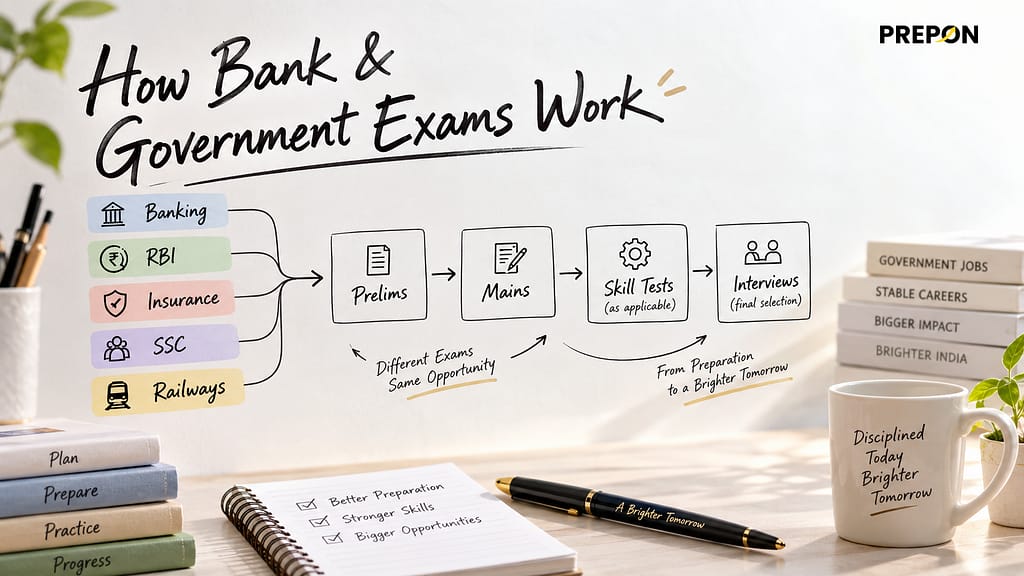
If you are starting government exam preparation alongside banking recruitment, one of the first things you will notice is that almost every major process — IBPS, SBI, RBI, LIC, SSC, or Railways — talks about "stages." Some call them Prelims and Mains. Others call them Phase I and Phase II, or Tier I and Tier II, or CBT 1 and CBT 2. It is tempting to assume these are all the same system wearing different names. They are not.
Freshness note: Recruitment structures in this guide reflect the latest official cycles verified up to 12 September 2026. Always check the current official notification before applying because stages, weightages and qualifying rules can change.
This government exam preparation guide walks through how twelve representative Banking, RBI, Insurance, SSC and Railway examinations are structured, why similarly named stages do not always mean the same thing, and how to plan your study strategy if you are targeting more than one of these recruitments.
Why Bank & Government Exam Structures Look Similar but Aren't Identical
Most large-scale Indian recruitment exams need to filter a very large applicant pool down to a manageable number of genuinely eligible candidates before conducting deeper assessment. That practical need is why so many exams share a similar shape: a first stage that screens, followed by a second stage that goes deeper.
But “Prelims,” “Phase I,” “Tier I” and “CBT 1” are labels chosen by different recruiting bodies for their own processes. They can perform a comparable screening function without carrying identical rules. Even where first-stage marks do not enter final merit, cut-offs, sectional requirements and shortlisting rules can differ substantially between exams. The only reliable way to know is to check the specific notification for the exam you are applying to — not to assume the label tells you the rule.
This distinction matters more than it sounds. Even where first-stage marks do not enter final merit — as with SBI PO’s Phase I and IBPS PO’s Prelims — cut-offs, sectional requirements and shortlisting rules can differ substantially between exams, so the presence or absence of a sectional cut-off should never be assumed from one exam to another.
The Building Blocks of a Recruitment Process
Rather than one universal formula, think of a recruitment process as a set of building blocks that a recruiting body assembles based on what the role requires.
Not every recruitment uses every stage.
Understanding why each stage exists makes it far easier to prepare for it correctly, instead of treating every stage as “just another exam to pass.”
Qualifying Marks vs Merit-Scoring Marks — Why This Distinction Matters More Than Stage Names
One of the most common planning mistakes is misunderstanding whether a stage’s marks actually count toward final selection.
In many of the representative recruitment cycles covered in this article, the first stage is used primarily for shortlisting, and its marks do not enter the final merit calculation. But this is not a rule you should assume applies everywhere — candidates must verify it in the specific recruitment notification they are applying under.
For example, in the current SBI PO cycle (CRPD/PO/2026-27/09), Phase I (Preliminary Examination) marks do not enter final merit, and Phase I currently carries no sectional cut-off — only Phase II (Main Examination) and Phase III (Psychometric Test, Group Exercise & Interview) contribute to the final score, with Phase II marks converted to 75 and Group Exercise plus Interview marks converted to 25 for that cycle.
In the current SSC CGL structure, Tier I functions as a qualifying stage, while Tier II is the stage that drives final merit. Within the current Tier II architecture, components such as the Computer Knowledge Test and DEST (Data Entry Speed Test) are qualifying in nature rather than merit-contributing.
- SBI PO — Phase I
- IBPS PO — Prelims
- SSC CGL — Tier I
- SSC CGL — Computer Knowledge Test & DEST
- SBI PO — Phase II
- SBI PO — Group Exercise & Interview
- IBPS PO — Mains & Interview
- SSC CGL — Tier II merit-scoring sections / papers
The takeaway: never assume a stage “doesn’t count” simply because it is called Prelims, Tier I, or Phase I. Confirm it against the specific notification every time.
How the 12 Representative Exams Compare at a Glance
Before looking at individual exam families in detail, it helps to see the full picture together. The table below summarises the stage sequence and interview status of twelve representative Bank, RBI, Insurance, SSC and Railway recruitments.
| Exam | Recruiting Body & Current Cycle | Stage Sequence | Interview? |
|---|---|---|---|
| IBPS PO | IBPS — CRP PO/MT-XVI (2026) | Prelims → Mains → Interview | Yes |
| SBI PO | SBI — CRPD/PO/2026-27/09 | Phase I → Phase II → Phase III (Psychometric Test, Group Exercise & Interview) | Yes |
| IBPS CSA | IBPS — CRP CSA-XVI | Prelims → Mains → Language Proficiency Test (where applicable) | No |
| SBI Junior Associate | SBI — CRPD/CR/2025-26/06 | Prelims → Mains → Local Language Test (where applicable) | No |
| RBI Assistant | RBI — Advt. No. 2A/2025-26 | Prelims → Mains (objective only) → Language Proficiency Test | No |
| RBI Grade B (DR)-General | RBI — Advt. No. 1A/2026-27 | Phase I → Phase II → Interview | Yes |
| LIC AAO | LIC — latest verified 2025 recruitment | Prelims → Mains → Interview → verification/medical as applicable | Yes |
| UIIC AO | UIIC — HO:HRM:REC:AO:1:2026 (7 Sept 2026) | Tier I (Preliminary) → Tier II (Main, with descriptive component) → Interview | Yes |
| NICL AO | NICL — latest verified cycle | Prelims → Mains → Interview | Yes |
| NIACL AO | NIACL — latest verified 2025 AO recruitment | Prelims → Mains → Interview | Yes |
| SSC CGL | SSC — 2026 cycle | Tier I → Tier II | No |
| RRB NTPC (Graduate) | Indian Railways — CEN 06/2025 | CBT 1 → CBT 2 → post-dependent CBAT/Typing Skill Test → Document Verification → Medical | No |
Officer-Level Banking Exams — IBPS PO and SBI PO
IBPS PO (CRP PO/MT-XVI — 2026) follows a Prelims → Mains → Interview structure. Prelims functions as a screening stage; Mains combines objective and descriptive components; the Interview follows. When commentators cite an 80:20 weighting between Mains and Interview marks for the final merit list, that ratio is specific to this recruitment cycle and should not be treated as a permanent IBPS policy — always confirm the current cycle’s ratio.
SBI PO (CRPD/PO/2026-27/09) uses a three-phase structure: Phase I (Preliminary Examination), Phase II (Main Examination), and Phase III (Psychometric Test, Group Exercise & Interview). As covered above, Phase I currently has no sectional cut-off and its marks do not carry into final merit; Phase II has sectional qualifying requirements and is converted to 75 marks; Group Exercise and Interview performance is converted to 25 marks. The psychometric assessment is part of Phase III but is not a separately scored component for final merit unless SBI’s official documentation states otherwise for a given cycle.
Both exams sit at the officer level and both include an interview — a pattern that is common at this level of banking recruitment but, as you will see below, is far from universal across all Bank and Government exams.
Clerical / Customer-Service Banking Exams — IBPS CSA and SBI Junior Associate
IBPS CSA (CRP CSA-XVI) — the Customer Service Associate role, still commonly referred to as “IBPS Clerk” for recognition — follows Prelims → Mains → Language Proficiency requirement or test, where applicable. There is no interview in this recruitment.
SBI Junior Associate (CRPD/CR/2025-26/06) follows Prelims → Mains → Specified Local Language Test, where applicable. Prelims functions as a screening stage; the Main Examination is the merit-driving written stage. Whether the language test applies to a given candidate depends on the proof and requirements specified in that notification. Like IBPS CSA, there is no interview.
The absence of an interview at the clerical/customer-service level, contrasted with its presence at the officer level in the same organisations, is a useful example of how the same recruiting body can run structurally different processes for different roles.
RBI Recruitment — RBI Assistant and RBI Grade B (DR)-General Are Not the Same Track
RBI Assistant and RBI Grade B (DR)-General follow very different recruitment and study tracks, even though both are conducted by RBI.
RBI Assistant (Advertisement No. 2A/2025-26, published February 2026) follows Preliminary Examination → Main Examination → Language Proficiency Test. Critically, the RBI Assistant Main Examination is objective only — covering Reasoning, English Language, Numerical Ability, General Awareness, and Computer Knowledge. There is no descriptive English paper in this recruitment, and there is no interview.
RBI Grade B (DR)-General (Advertisement No. 1A/2026-27) follows Phase I → Phase II → Interview. This article uses RBI Grade B (DR)-General as the representative Grade B example; DEPR and DSIM follow different examination schemes. Phase II requires a substantially different kind of preparation, covering Economic & Social Issues, Finance & Management, and English Writing Skills — none of which appear in RBI Assistant. RBI Grade B (DR)-General should not be described as merely a harder version of Bank PO; its Phase II requirements create a genuinely separate study track centred on economics, finance, management concepts, and structured writing, layered on top of (rather than replacing) general aptitude preparation.
If you are preparing for RBI Assistant, your Main-stage work stays objective and aptitude-based. If you are preparing for RBI Grade B (DR)-General, you need to budget separate time for economic and financial concepts and for developing written-English proficiency — well before Phase II approaches.
Insurance-Sector AO Exams — LIC, UIIC, NICL, NIACL
Insurance-sector Administrative/Assistant Officer recruitments are often assumed to be interchangeable because they all sit under the general insurance or life insurance umbrella. In practice, each organisation runs its own recruitment, and their later-stage requirements differ.
LIC AAO (latest verified 2025 recruitment) broadly follows Prelims → Mains → Interview → subsequent verification/medical requirements, as applicable. LIC recruits through both Generalist and Specialist streams, and these should not be automatically conflated — their syllabi and evaluation differ. For the Generalist stream specifically, the Main Examination includes an Insurance & Financial Market Awareness component. This exact section should not be assumed to apply, by name, to every other insurance AO exam.
UIIC AO (HO:HRM:REC:AO:1:2026, dated 7 September 2026) broadly follows Tier I Preliminary Examination → Tier II Main Examination with a descriptive component → Interview. Detailed marks, sectional weightages, cut-offs and final-merit rules should be verified against the current official notification before finalising your preparation plan.
NICL AO broadly follows Prelims → Mains → Interview, based on its latest verified recruitment cycle. Depending on the stream (Generalist vs Specialist), descriptive or professional-knowledge components may differ — check the specific notification for the stream you are applying under.
NIACL AO also broadly follows Prelims → Mains → Interview, based on its latest verified 2025 AO recruitment. NICL and NIACL are both general insurers, but that does not make their recruitment structures identical — NICL-specific professional-knowledge or medical requirements should not be assumed to carry over to NIACL, or vice versa.
Where a single label is useful across these four exams, “insurance/sector awareness — varies by organisation and stream” is more accurate than assuming a universal “Insurance Awareness” paper exists everywhere.
SSC CGL — A Central Government Exam Without an Interview
SSC CGL, unlike the banking and insurance exams above, currently follows a Tier I → Tier II structure, with no interview. In the current verified cycle, Tier I is qualifying, while Tier II drives final merit. Within Tier II’s current architecture, the Computer Knowledge Test and DEST (Data Entry Speed Test) function as qualifying components rather than contributing marks to the merit list. Older standalone Tier III/Tier IV structures are not part of the current cycle and should not be assumed to still apply.
SSC CGL is a useful contrast case for candidates coming from a banking-study background: no interview stage, a different weighting of General Studies and English content, and its own approach to skill-test qualification.
RRB NTPC — How a Railways Exam Differs from Banking and SSC
RRB NTPC — Graduate (CEN 06/2025) is used here as the representative Railways example (not CEN 01/2026, which relates to ALP recruitment, not NTPC). Its representative structure is:
CBT 1 → CBT 2 → post-dependent CBAT or Typing Skill Test → Document Verification → Medical Examination
There is no interview anywhere in this process. Whether a candidate takes a Computer-Based Aptitude Test (CBAT) or a Typing Skill Test depends on the specific post applied for — not every candidate takes the same later-stage test, and how the final score is treated also varies by post.
A subject-level distinction matters here: RRB NTPC’s CBT stages test Mathematics, General Intelligence & Reasoning, and General Awareness. There is no standalone English Language section and no separate Computer Knowledge paper as a core CBT subject — a meaningful difference from banking, RBI, insurance, and SSC CGL, all of which give English a more prominent, often standalone, role.
What You Can Prepare Once — and What You Can't
Once you see these twelve exams side by side, a genuine pattern emerges — but it is a qualitative pattern, not a percentage. No credible source can tell you that “80% of the syllabus is common” across these exam families, and any preparation content that claims otherwise should be treated with caution.
What can be said with confidence is this:
- Quantitative Aptitude / Mathematics
- Reasoning / General Intelligence
- English Language where relevant
- General Awareness habits
- Basic test-taking discipline
- Banking / Financial Awareness
- RBI Grade B (DR)-General: ESI, Finance & Management, English Writing Skills
- Insurance / sector awareness
- SSC-specific General Studies breadth
- RRB NTPC-specific structure
- Descriptive writing
- Language Proficiency Tests
- CBAT / typing / skill requirements
- Interview / personality readiness
A note on Awareness terminology: General Awareness, Current Affairs, Banking Awareness, Financial Awareness, Economic Awareness, and Insurance Awareness are related but distinct categories. An SSC CGL or RRB NTPC candidate still needs General Awareness and Current Affairs — the fact that Banking Awareness or Insurance Awareness is not relevant to them does not mean Awareness study as a whole can be skipped.
A note on current affairs coverage: there is no single official current-affairs month range that applies uniformly across these exams. Coaching providers often recommend rolling, ongoing current-affairs coverage rather than a fixed look-back window — but that is editorial study advice, not an official requirement of any specific recruitment.
Can You Prepare for Multiple Exams at Once? Practical Combinations
In short: Quant and Reasoning are your most transferable investment across nearly all these recruitments. English transfers well across Banking, RBI, Insurance, and SSC CGL, but not to RRB NTPC’s core CBT. Everything beyond that — sector-specific awareness, descriptive writing, language tests, interviews, and RRB’s own structure — needs deliberate, target-specific study time.
When Should Mains-Specific Study Begin?
A common question is whether it makes sense to prepare for Mains-level content only after clearing Prelims. Waiting until Prelims is over to begin Mains-specific study can create a serious preparation gap, especially where the later stage follows quickly or introduces content that Prelims study does not cover at all — descriptive writing, Economic & Social Issues, Finance & Management, or professional/domain knowledge, for instance.
This does not mean neglecting Prelims study. It means recognising that certain Mains-specific skills — particularly writing ability and domain-specific awareness — benefit from an early start that runs in parallel with, rather than strictly after, Prelims-focused aptitude practice.
After the Written Exams — Language Tests, Skill Tests, Interviews, DV & Medical
Several stages appear after the main written examination, depending on the exam and the post:
None of these later stages are universal — which one applies to you depends entirely on the exam and post you are pursuing.
Building Your Government Exam Preparation Plan
Bringing this together, a workable approach looks like this:
A strong government exam preparation plan starts with deciding which recruitments to target together and how to sequence your study. A personalised plan can be more useful than a generic timetable. Talk to a PREPON Mentor about your bank exam preparation plan, or explore the Bank & Government Sampurna Programme.
Frequently Asked Questions
Do all bank exams have interviews?
No. Officer-level recruitments such as IBPS PO and SBI PO include an interview, while clerical/customer-service recruitments such as IBPS CSA and SBI Junior Associate currently do not. RBI Grade B (DR)-General includes an interview, while RBI Assistant does not.
Does RBI Assistant have descriptive English?
No. The RBI Assistant Main Examination under Advertisement No. 2A/2025-26 is objective only, covering Reasoning, English Language, Numerical Ability, General Awareness and Computer Knowledge. It does not include a descriptive English paper, and there is no interview in this recruitment.
What is an LPT?
An LPT is a Language Proficiency Test or language-proficiency requirement used to confirm that a candidate can work in the locally required language. It is relevant to recruitments such as SBI Junior Associate, IBPS CSA and RBI Assistant where the current notification makes it applicable.
What is DEST?
DEST stands for Data Entry Speed Test. In the current SSC CGL structure, it is a mandatory qualifying component of Tier II for all posts, subject to the exemptions specified in the official notice. Certain posts may require a higher qualifying standard.
What is CBAT?
CBAT stands for Computer-Based Aptitude Test. In RRB NTPC Graduate recruitment, it is a post-dependent stage for specified posts that require additional assessed aptitude. Not every NTPC candidate takes CBAT.
Is English required for RRB NTPC?
Not as a standalone CBT section. RRB NTPC CBT stages currently test Mathematics, General Intelligence & Reasoning and General Awareness. There is no separate English Language paper and no standalone Computer Knowledge paper in the CBT structure.
What is the difference between Prelims and Mains?
Prelims usually functions as the earlier screening stage, while Mains is generally the deeper assessment used to differentiate shortlisted candidates. The exact scoring, cut-offs and contribution to final merit vary by recruitment, so the current official notification remains the final authority.
Do Prelims marks count in final selection?
In many of the representative cycles covered here, first-stage marks are used for shortlisting and do not enter final merit. That should not be treated as a universal rule. Candidates should verify the current notification for the exact recruitment they are targeting.
Are Phase I, Tier I and CBT 1 the same as Prelims?
No. These labels can describe comparable early-stage screening functions, but they belong to different recruitment systems and do not guarantee identical cut-offs, sectional rules or merit treatment. Always read the rules for the specific examination.
Can SBI and IBPS exams be prepared for together?
Yes, to a large extent. SBI and IBPS officer and clerical recruitments share a strong aptitude base in Quant, Reasoning and English, with awareness work also overlapping. Exact patterns, sectional requirements, interviews and final-merit rules still need target-specific study.
Can banking and insurance recruitments be targeted together?
Yes, particularly at the aptitude-foundation level. Quant, Reasoning and English transfer well, but insurance-sector recruitments can add organisation- or stream-specific awareness, descriptive or professional-knowledge requirements that need separate study.
Can PO and SSC CGL be targeted together?
They share useful work in Quant, Reasoning and English, but SSC CGL requires its own General Studies breadth and follows a different selection architecture. A combined plan should therefore keep a shared aptitude core while adding SSC-specific study.
Why does RBI Grade B (DR)-General need a separate track?
Its Phase II includes Economic & Social Issues, Finance & Management and English Writing Skills. These areas are not covered in standard PO study at the required depth, so RBI Grade B (DR)-General needs a distinct second-stage track.
When should Mains-specific study begin?
Do not automatically wait for the Prelims result. Descriptive writing, domain knowledge, ESI, Finance & Management and similar Mains-specific areas benefit from earlier study, especially when the later stage follows soon after the screening stage.
What happens after the written examination?
Depending on the recruitment and post, later stages may include a Language Proficiency Test, DEST, CBAT, typing or other skill tests, an interview, document verification and medical examination. Not every recruitment uses every stage.
Do all insurance AO recruitments have the same syllabus?
No. LIC, UIIC, NICL and NIACL conduct separate recruitments, and Generalist/Specialist streams can differ as well. For example, LIC AAO Generalist has a verified Insurance & Financial Market Awareness component, but that exact section should not be assumed across every insurer recruitment.