Most people searching for the government pay scale in India expect one master table covering every public job. That table does not exist. Central Government departments, public-sector banks, RBI, financial regulators, insurers and Railways use different classification and pay systems.
Central Government posts use Groups and Pay Levels. Public-sector banks use cadres and officer Scales. RBI and regulators such as SEBI, PFRDA and IFSCA use organisation-specific Grades. Insurers use their own Scale structures. Railways combines Central Pay Levels with recruitment categories and legacy terminology.
The easiest way to read any notification is to ask five questions: Entry → Position → Work → Pay → Promotion. This guide applies that framework across the major systems so you can tell what a title means, where the job sits, how the pay is structured and what comes next.
How the Government Pay Scale in India Actually Works
There is no single pay and classification system covering every Central Government department, public-sector bank, regulator, insurer and public institution in India. Instead, several employment systems operate side by side.
For Central Government civilian posts, classification comes from the applicable rules and Recruitment Rules, while the 7th Central Pay Commission Pay Matrix determines the Pay Level and Basic Pay progression. Public-sector banks follow industry wage settlements and officer Scales. RBI and statutory regulators have their own employee regulations. LIC and public-sector general insurers have separate pay structures. Railways uses Central Pay Levels but also retains older recruitment terminology in official communication.
That is why the government pay scale in India is better understood as a set of parallel systems rather than one ladder. The government job hierarchy in India is therefore a collection of employer-specific ladders, not one national chain of command.
Concept Dictionary: Group, Grade, Scale, Pay Level and More
| Term | Plain-English Meaning | Used Mainly In | Example | Do Not Confuse With |
|---|---|---|---|---|
| Group | Formal classification of Central Government civilian posts | Central Government | Group B | Organisation-specific Grade |
| Grade | Internal organisational tier defined by an employer’s service rules | RBI, SEBI, PFRDA, IFSCA, NABARD and similar institutions | SEBI Grade A | Central Government Group |
| Scale | Pay/career band, especially in banks and insurers | PSBs, RRBs, insurers | JMGS-I / Scale I | Central Pay Level |
| Pay Level | One of the levels in the Central Pay Matrix that determines Basic Pay progression | Central Government, Railways | Pay Level 7 | Bank Scale |
| Cadre | A defined body of posts within a service or organisation | Government services, banks | CSS cadre | Designation |
| Service | Organised personnel system with its own rules and career path | Central Government | Central Secretariat Service | One individual post |
| Post | A sanctioned job position | Any employer | Income Tax Inspector | Pay Level or Grade |
| Designation | The job title used for the employee | Any employer | Assistant Manager | Underlying Scale/Grade |
| Rank | In this article’s civilian/banking context, often a loose way to describe seniority; in military/police systems it can be a formal classification | General usage; uniformed services formally | Police rank | Group/Grade/Scale |
| Gazetted | A Central Government post whose appointment is formally notified in the Gazette | Central Government | Section Officer | Every Group B post |
| Non-Gazetted | A post not classified as Gazetted | Central Government | CSS Assistant Section Officer | “Junior” or “low-paid” |
| Probation | Trial/confirmation period after joining | Government, banks, regulators | PO probation | A separate Grade |
| Probationary Officer | Direct officer-entry designation/status in banking during probation | Banks | SBI PO | Central Government Group A |
| Management Trainee | Structured trainee entry before absorption into a regular Grade/Scale | EXIM Bank and some institutions | EXIM MT | Universal permanent rank |
| Specialist Officer | Officer recruited for a professional discipline | Banks/financial institutions | IT Officer, Law Officer | Generalist PO |
| Promotion | Movement to a higher post, Grade or Scale | All systems | Scale I → Scale II | Annual increment |
| Deputation | Temporary service in another organisation while retaining parent-cadre linkage | Government/public institutions | IAS officer on deputation | Permanent transfer |
| Lateral Recruitment | Direct hiring into a mid/senior role from outside the normal entry pipeline | Government, banks, regulators | Experienced Scale II/III hire | Internal promotion |
The key lesson is simple: identical words can describe different things depending on the employer.
Salary Glossary: Basic Pay, Gross, In-Hand and CTC
Understanding the government job salary structure within the government pay scale in India starts with separating the salary terms.
There is no universal conversion formula. The same Basic Pay can produce different Gross or CTC figures at RBI, SEBI, a public-sector bank or a Central Government department because the allowances and benefits differ.
Central Government Classification: Group A, B, C and Erstwhile Group D
Central Government civilian posts form the largest rule-based segment of the government pay scale in India and are formally classified under the applicable rules and Recruitment Rules.
Group A broadly includes senior executive, administrative, technical and professional posts. These are generally Gazetted.
Group B includes supervisory and middle-level posts. Some are Gazetted and others are Non-Gazetted.
Group C includes clerical, operational and support posts.
The old Group D category was abolished/reclassified after the 6th CPC changes, with those posts absorbed into Group C. The phrase survives most visibly in Railways recruitment, which is discussed separately below.
A common mistake in searches for group a b c government jobs and government job grades in India is to assume the Pay Level alone determines the Group. It does not. Pay Level helps you understand pay and functional seniority, but the legal classification of a post comes from the relevant rules.
A useful exception is the Central Secretariat Service Section Officer. A CSS Section Officer is Group B Gazetted at Pay Level 8 and receives a non-functional Level 10 after four years of approved service while remaining Group B Gazetted. So “Level 10 = Group A” is not a safe rule.
Source: DoPT — Central Secretariat Service cadre/classification information.
7th CPC Pay Matrix: Understanding Pay Levels
A Pay Level is one of the levels in the Central Pay Matrix that determines the applicable Basic Pay progression for a Central Government post. These are the government pay levels in India used for Central Government civilian pay. The table below shows the entry Basic Pay for Levels 1–10.
| Pay Level | Entry Basic Pay | Representative Context |
|---|---|---|
| Level 1 | ₹18,000 | Entry support/operational posts |
| Level 2 | ₹19,900 | Junior clerical/support posts |
| Level 3 | ₹21,700 | Selected clerical/uniformed/support posts |
| Level 4 | ₹25,500 | Tax Assistant and similar Group C posts |
| Level 5 | ₹29,200 | Auditor/Accountant and similar posts |
| Level 6 | ₹35,400 | Divisional Accountant and other Level-6 posts |
| Level 7 | ₹44,900 | CSS ASO, Income Tax Inspector and many CGL Group B posts |
| Level 8 | ₹47,600 | Assistant Audit Officer; CSS Section Officer |
| Level 9 | ₹53,100 | Selected promotional/supervisory posts depending on cadre |
| Level 10 | ₹56,100 | Entry level for many Group A services; also CSS SO non-functional level after four years |
The Pay Matrix extends beyond Level 10 up to Level 18. The important point is that Pay Level and Group are related but not interchangeable.
Source: Department of Expenditure — CCS (Revised Pay) Rules, 2016 / 7th CPC Pay Matrix.
8th Central Pay Commission: What Has and Has Not Changed
The 8th Central Pay Commission was formally constituted on 3 November 2025. It was given 18 months to submit its report. The Commission is chaired by Justice Ranjana Prakash Desai, with Prof. Pulak Ghosh as Part-time Member and Pankaj Jain as Member-Secretary.
As of 15 September 2026, the 7th CPC Pay Matrix remains the operative framework. No 8th CPC Pay Matrix has been implemented.
The latest officially implemented Central Government DA located for this article is 60% of Basic Pay, effective 1 January 2026, after a two-percentage-point increase from 58%.
Avoid treating social-media salary projections as current government pay.
Source: 8th Central Pay Commission — Official About page] [Source: PIB/Ministry of Finance — DA increase effective 1 January 2026.
Ministries and the Central Secretariat
A Ministry is an administrative workplace, not a separate pay system. The employee’s cadre, post, Group and Pay Level determine the personnel position.
For the Central Secretariat Service (CSS), the core ladder is:
| CSS Grade/Post | Classification | Pay Level |
|---|---|---|
| Assistant Section Officer | Group B, Non-Gazetted | Level 7 |
| Section Officer | Group B, Gazetted | Level 8; Level 10 after four years of approved service |
| Under Secretary | Group A, Gazetted | Level 11 |
| Deputy Secretary | Group A, Gazetted | Level 12 |
| Director | Group A, Gazetted | Level 13 |
Senior Ministry posts such as Joint Secretary, Additional Secretary and Secretary can be filled through the Central Staffing Scheme and other applicable arrangements, including officers from IAS and other Group A services. Not every Ministry has an identical staffing pattern.
The practical work also changes sharply as the ladder rises. An ASO is primarily a caseworker: examining files, checking rules and precedents, drafting notes and replies, and coordinating with attached offices or other Ministries. A Section Officer supervises the section, reviews the work of ASOs and is responsible for the quality and movement of cases. Under Secretaries and Deputy Secretaries take on wider policy, coordination and decision-support responsibilities, while Directors handle larger subject areas and provide senior-level administrative oversight.
This progression is useful because it shows why a change in designation is not merely a pay increase; it usually changes the level of accountability and decision-making as well.
Source: DoPT — Central Secretariat Service.
SSC Is a Recruiter, Not a Job Grade
The Staff Selection Commission (SSC) recruits for posts across different departments, Groups and Pay Levels, so SSC jobs span several parts of the government pay scale in India rather than one salary band. That is why ssc pay levels vary: SSC CGL is an examination, not one job.
Representative SSC CGL 2026 posts include:
| Post | Department/Organisation | Group | Gazetted? | Pay Level | Entry Basic | What They Do |
|---|---|---|---|---|---|---|
| Assistant Audit Officer | C&AG / Indian Audit & Accounts Department | Group B | Gazetted | Level 8 | ₹47,600 | Audit government expenditure and accounts |
| Assistant Section Officer (CSS) | Central Secretariat Service | Group B | Non-Gazetted | Level 7 | ₹44,900 | File work, noting, drafting and coordination |
| Inspector of Income Tax | CBDT | Group B | Non-Gazetted | Level 7 | ₹44,900 | Tax administration, verification and enforcement work |
| Inspector (Central Excise) | CBIC | Group B | Non-Gazetted | Level 7 | ₹44,900 | Indirect-tax/GST enforcement and compliance functions |
| Inspector (Preventive Officer) | CBIC/Customs | Group B | Non-Gazetted | Level 7 | ₹44,900 | Customs preventive and anti-smuggling work |
| Inspector (Examiner) | CBIC/Customs | Group B | Non-Gazetted | Level 7 | ₹44,900 | Examination of import/export consignments |
| Assistant Enforcement Officer | Directorate of Enforcement | Group B | Non-Gazetted | Level 7 | ₹44,900 | Enforcement/investigation under economic laws |
| Sub-Inspector, CBI | Central Bureau of Investigation | Group B | Non-Gazetted | Level 7 | ₹44,900 | Criminal investigation |
| Divisional Accountant | C&AG | Group B | Non-Gazetted | Level 6 | ₹35,400 | Accounts control/advice in public works divisions |
| Auditor | C&AG/CGDA and other offices | Group C | Non-Gazetted | Level 5 | ₹29,200 | Audit checking and scrutiny |
| Accountant | Various offices | Group C | Non-Gazetted | Level 5 | ₹29,200 | Government accounting work |
| Tax Assistant | CBDT/CBIC | Group C | Non-Gazetted | Level 4 | ₹25,500 | Processing, data and tax-administration support |
SSC CHSL recruits junior clerical/data-entry posts, SSC MTS recruits Level-1 support posts, and SSC CPO recruits Sub-Inspectors in specified police/CAPF organisations. The exact classification depends on the post.
Source: SSC — Combined Graduate Level Examination 2026 Notice.
Indian Railways: Why “Group D” Still Appears
Within the Railway part of the government pay scale in India, erstwhile Central Government Group D posts were absorbed/reclassified within Group C after the 6th CPC changes. Yet Railway Recruitment Boards continue to use expressions such as “Pay Level-1 / Group-D Posts” and “Level-1 (Group-D)” in official recruitment communication.
So the term survives for two reasons: historical continuity and current Railway recruitment usage.
Representative Railway recruitment categories include:
- Level-1 / Group-D posts: Track Maintainer and various assistant roles.
- NTPC Undergraduate: Junior Clerk cum Typist and similar posts.
- NTPC Graduate: Goods Train Manager, Station Master and other graduate posts.
- ALP: Assistant Loco Pilot.
- Technician: trade/technical maintenance posts.
- JE: Junior Engineer, typically a technical supervisory role.
Railway Recruitment Boards should also not be confused with Regional Rural Banks, which use the same abbreviation “RRB” in banking.
Aspirants should also separate the recruitment category from the actual work. A Station Master manages train movement and station operations; a Goods Train Manager has operational responsibility connected with freight-train running; an ALP assists in locomotive operation; a JE supervises technical work. Two Railway posts can therefore sit at different Pay Levels even though both are recruited through an RRB. The safest way to compare them is always post + Pay Level + job function, not the exam name alone.
Source: Railway Recruitment Board Chandigarh — Recruitment Notices, Pay Level-1 / Group-D Posts.
Public-Sector Bank Career Ladder
Public-sector banks form a separate branch of the government pay scale in India, using a different system from Central Government Groups. The usual bank officer hierarchy is:
For readers searching for bank officer scale 1 to 7, the current officer scales under the 9th Joint Note are:
| Scale | Starting Basic | Full Scale |
|---|---|---|
| Clerical/CSA | ₹24,050 | Up to ₹64,480 |
| JMGS-I | ₹48,480 | ₹48,480–₹85,920 |
| MMGS-II | ₹64,820 | ₹64,820–₹93,960 |
| MMGS-III | ₹85,920 | ₹85,920–₹1,05,280 |
| SMGS-IV | ₹1,02,300 | ₹1,02,300–₹1,20,940 |
| SMGS-V | ₹1,20,940 | ₹1,20,940–₹1,35,020 |
| TEGS-VI | ₹1,40,500 | ₹1,40,500–₹1,56,500 |
| TEGS-VII | ₹1,56,500 | ₹1,56,500–₹1,73,860 |
A PO usually enters the officer cadre at Scale I. Specialist Officers may also enter at Scale I or higher, depending on the recruitment. Experienced candidates can be recruited directly into higher Scales where a notification permits it. Clerical employees can move into the officer cadre through internal promotion.
Designation names such as Assistant Manager, Manager, Chief Manager, AGM, DGM and GM vary between banks. Scale is the safer cross-bank reference.
The work changes as officers rise. Scale-I officers typically rotate through branch operations, customer service, deposits, credit processing and basic supervision. At Scale II and III, managers take larger credit decisions, supervise teams and may head branches or specialist units. Senior Management Scales increasingly involve regional, zonal, corporate, risk, treasury, credit, HR or business responsibilities. By Scale VI and VII, the job is primarily senior executive management rather than counter-level branch work. This is why the Scale is a better indicator of career position than a designation alone.
Source: SBI/IBA — 9th Joint Note salary revision.
IBPS: Recruitment Mechanism, Not Employer
The Institute of Banking Personnel Selection conducts common recruitment processes for participating organisations. Current verified 2026 cycles for this article are:
CSA recruitment is for clerical/customer-service roles. PO/MT is direct officer recruitment, normally into Scale I of participating banks. Specialist Officer recruitment covers professional streams such as IT, Law, Agriculture, HR, Marketing and Rajbhasha. RRB recruitment covers Regional Rural Banks.
As of 15 September 2026, these are the current verified IBPS recruitment cycles listed for this guide.
SBI: Separate From IBPS
State Bank of India conducts its own recruitment.
SBI Junior Associate is SBI’s clerical entry route.
SBI Probationary Officer is direct officer entry. Under the verified Scale-I structure, SBI PO begins at ₹56,480 Basic Pay after four advance increments over the Scale-I minimum.
Do not compare SBI PO CTC with an IBPS PO Basic Pay figure without checking exactly what each number includes.
Regional Rural Banks: “Group A” and “Group B” Mean Something Else
IBPS RRB notifications use:
- Group A — Officers
- Group B — Office Assistants
These are recruitment labels within the RRB system, not Central Government Group classifications.
RRB roles include:
- Office Assistant (Multipurpose)
- Officer Scale I
- Officer Scale II
- Officer Scale III
Office Assistants handle clerical and customer-facing work. Officer Scale I is the general entry officer level, while Scale II and III posts are more senior and can include general banking as well as specialist recruitment. Because RRBs are separate banking institutions with a rural and semi-urban mandate, their service conditions and allowances should be checked in the specific notification rather than copied from a large PSB.
A Regional Rural Bank “Group A Officer” should never be described as a Central Government Group A officer merely because the same letter is used.
Bank Promotions
Bank employees can move from clerical cadre to officer cadre and then through Scale I to Scale VII, but there is no single industry-wide timetable.
A bank’s promotion policy may consider:
- Qualifying service
- Seniority
- Merit
- Performance appraisal
- Written tests
- Interviews
- Rural/branch experience
- Vacancies
- Bank-specific promotion rules
This is why two employees who joined at the same Scale can progress at different speeds.
JAIIB and CAIIB
JAIIB and CAIIB are professional qualifications conducted by the Indian Institute of Banking & Finance (IIBF).
Depending on the applicable settlement and employee category, they can affect professional qualification pay/increments and may matter in bank-specific promotion policies.
MBA and Other Professional Qualifications
An MBA does not automatically make someone a manager, and it is not required for ordinary IBPS PO or SBI PO recruitment.
MBA/PGDM becomes more relevant in:
- Specialist HR or Marketing roles
- Credit/finance positions where a notification asks for management qualifications
- Experienced direct recruitment
- Lateral roles
Other qualifications matter where the role itself requires them:
- CA/finance
- Law
- Engineering
- Economics
- Statistics
- Actuarial
- IT/data science
Qualification alone does not determine organisational Grade or Scale. The recruitment route and applicable service rules do.
Management Trainee: EXIM Bank Example
Management Trainee is a training/entry mechanism, not a universal rank.
EXIM Bank recruitment terms are advertisement-specific. A 2026–27 Management Trainee recruitment is currently listed on the Bank’s careers page, so candidates should use that live advertisement for the current stipend, training period and absorption terms.
Source: EXIM Bank — Careers.
RBI: Assistant and Grade B Are Different Tracks
The Reserve Bank of India has its own employee Grades and pay structure within the broader government pay scale in India. The RBI grades hierarchy must therefore be read independently of Central Government Groups.
RBI Assistant
- Starting Basic Pay: ₹29,000
- Scale: ₹29,000–₹78,640
- Initial official gross: about ₹58,514 excluding HRA
- HRA: 15% of Pay where applicable and Bank accommodation is not provided
Assistants handle clerical, administrative and operational support across RBI offices.
Source: RBI — Assistant Recruitment 2026.
RBI Grade B
- Starting Basic Pay: ₹78,450
- Scale: ₹78,450–₹1,41,600
RBI Grade B recruitment includes General, DEPR and DSIM streams. Work can cover supervision, regulation, central-banking operations, economic research, policy analysis and statistics.
Source: RBI — Grade B Recruitment 2026.
NABARD: Grade A
NABARD is the apex development institution focused on agriculture and rural development finance.
The latest officially verified Grade A recruitment in the source set used for this article is the 2025 recruitment, with:
- Starting Basic Pay: ₹44,500
- Scale: ₹44,500–₹89,150
- Initial gross: approximately ₹1,00,000 per month under the notification’s stated conditions
Do not assume NABARD Grade A has the same pay as SEBI/PFRDA Grade A simply because the Grade label is the same.
Source: NABARD — Grade A Recruitment 2025.
SEBI: Grade A to Executive Director
The Securities and Exchange Board of India regulates India’s securities market.
| Grade | Designation | Starting Basic |
|---|---|---|
| Junior Assistant | — | ₹29,000 |
| Grade A | Assistant Manager | ₹62,500 |
| Grade B | Manager | ₹78,450 |
| Grade C | Assistant General Manager | ₹1,10,850 |
| Grade D | Deputy General Manager | ₹1,53,200 |
| Grade E | General Manager | ₹1,67,000 |
| Grade F | Chief General Manager | ₹2,57,500 |
| Executive Director | Executive Director | ₹3,12,000 |
Grade A full scale: ₹62,500–₹1,26,100.
For the current Grade A recruitment, official Mumbai gross is approximately ₹1.84 lakh without accommodation and ₹1.43 lakh with accommodation.
Source: SEBI — Pay Scales / Grade A Recruitment.
PFRDA: Separate Organisation, Similar Published Starting Pays
The Pension Fund Regulatory and Development Authority regulates India’s pension sector.
| Grade | Starting Basic |
|---|---|
| Junior Assistant | ₹29,000 |
| Grade A | ₹62,500 |
| Grade B | ₹78,450 |
| Grade C | ₹1,10,850 |
| Grade D | ₹1,53,200 |
| Grade E | ₹1,67,000 |
| Grade F | ₹2,57,500 |
| Executive Director | ₹3,12,000 |
Grade A full scale: ₹62,500–₹1,26,100.
PFRDA issued a fresh Grade A recruitment advertisement on 3 September 2026. Current published starting-pay figures across several PFRDA Grades align with corresponding SEBI figures, but the two bodies remain separate statutory organisations with their own service regulations.
Source: PFRDA — Grade A recruitment and vacancies.
IFSCA: Grade A in GIFT City
The International Financial Services Centres Authority regulates financial services and products in India’s International Financial Services Centres, especially GIFT City.
For Grade A:
- Starting Basic Pay: ₹62,500
- Scale: ₹62,500–₹1,26,100
- Approximate official gross at the minimum: ₹1.80 lakh per month, including specified allowances and IFSCA’s NPS contribution
- Phase II weight in final selection: 85%
- Interview weight: 15%
Source: IFSCA — Officer Grade A Recruitment.
IRDAI
The Insurance Regulatory and Development Authority of India regulates insurers, insurance intermediaries and policyholder-protection standards.
A sufficiently current 2026 official IRDAI pay revision was not verified with the same confidence as the SEBI, PFRDA and IFSCA figures, so this guide does not quote a numeric current IRDAI pay figure.
SIDBI
The Small Industries Development Bank of India finances and supports the MSME sector.
Recent recruitment material has published Grade A/Grade B scales, but SIDBI itself has stated that the relevant pay scales are due for revision. Accordingly, older published figures should be labelled as the latest recruitment scales found rather than presented as unquestioned current 2026 pay.
NHB
The National Housing Bank supports the development of India’s housing-finance system and performs development/refinance functions. It should not be described as the current prudential regulator of Housing Finance Companies: regulatory authority over HFCs was transferred to the Reserve Bank of India with effect from 9 August 2019.
NHB recruits through organisation-specific regular, contractual, deputation and senior-level notices. Where a current pay figure is needed, use the specific live NHB notification rather than forcing NHB into a PSB or regulator template.
Source: RBI — Transfer of HFC regulation from NHB to RBI.
ECGC: Probationary Officer
ECGC provides export-credit insurance and credit-risk cover for exporters and banks.
The FY 2025–26 PO recruitment uses:
- Scale: ₹88,635–₹1,69,025
- Approximate annual CTC in Mumbai: ₹20 lakh, under the assumptions stated in the notification
The role involves export-credit insurance, country/buyer risk assessment and claims/underwriting work.
Source: ECGC — Probationary Officer Recruitment FY 2025–26.
LIC: AAO and ADO Are Different
Life Insurance Corporation of India uses its own employee structure.
AAO — Assistant Administrative Officer
- Administrative/generalist/specialist officer route
- Starting Basic: ₹88,635
- Scale: ₹88,635–₹1,69,025
- Official initial monthly emoluments: approximately ₹1.26 lakh in an A-class city
ADO — Apprentice Development Officer
- Agency-development and field-sales supervision route
- Recruits, trains and supports insurance agents
LIC also has Assistant/Higher Grade Assistant cadres at more junior levels.
The work profile is also very different. An AAO may work in policy servicing, claims, finance, legal, IT, actuarial, audit or administration depending on the stream and posting. An ADO, by contrast, is much closer to sales-force development: building and supervising an agency network and supporting business development. The similar abbreviations hide two fundamentally different career experiences.
Source: LIC — AAO Recruitment 2025.
Public-Sector General Insurance: UIIC as a Worked Example
NIACL, NICL, OICL, UIIC and GIC Re have their own service structures. UIIC provides a useful verified Scale example:
| Scale | Starting Basic |
|---|---|
| Scale I | ₹50,925 |
| Scale II | ₹68,425 |
| Scale III | ₹83,425 |
| Scale IV | ₹1,02,185 |
| Scale V | ₹1,23,605 |
| Scale VI | ₹1,38,335 |
| Scale VII | ₹1,55,015 |
Functions across public-sector general insurers include:
- Underwriting
- Claims
- Actuarial
- Finance
- Legal
- IT
- HR
- Marketing
- Reinsurance
Do not assume every insurer maps the same designation to the same Scale.
At the officer level, general insurers also offer specialist career paths. Underwriters evaluate risk and price policies; claims officers examine losses and settlement liability; actuarial teams model risk and reserves; finance teams handle accounts and investments; legal teams manage disputes and regulatory issues; reinsurance teams decide how much risk the insurer retains or passes on. A Scale number tells you seniority, but the functional stream tells you what the officer actually does.
Source: UIIC — Officer Pay-Scale Disclosure.
How Senior Leaders Are Appointed
Senior leadership is reached through different routes depending on the institution:
- Internal promotion
- Statutory appointment
- Government appointment
- FSIB recommendation
- ACC approval
- Deputation
- Board selection
- Lateral recruitment
There is no universal appointment formula. FSIB and ACC are important for specific public-sector financial appointments, but they do not appoint every regulator Chairperson, insurer executive, PSU GM or Government Secretary through one common process.
The route also changes with the type of organisation. In a Ministry, senior positions may be filled through cadre promotion or the Central Staffing Scheme. In a public-sector bank or insurer, internal career progression can lead to senior executive grades, while Board-level posts may involve a separate Government-led selection and appointment process. Statutory regulators have appointment mechanisms defined by their governing Acts and rules. A senior title therefore cannot tell you the appointment route by itself.
Master Comparison Table
The government pay scale in India becomes easier to understand when each organisation is kept inside its own system:
| System / Organisation | Entry Route | Representative Post | Group / Grade / Scale | Pay Level | Starting Basic | Official Gross / CTC if Published | What They Do | Promotion Direction |
|---|---|---|---|---|---|---|---|---|
| Central Government / CSS | SSC/direct/promotion | ASO | Group B, Non-Gazetted | Level 7 | ₹44,900 | Varies by posting and allowances | Ministry administration | SO → US → DS → Director |
| SSC-recruited CBDT | SSC CGL | Income Tax Inspector | Group B, Non-Gazetted | Level 7 | ₹44,900 | Varies by posting and allowances | Tax administration/enforcement | Departmental cadre promotion |
| Indian Railways | RRB recruitment | Level-1 post | Group C; officially marketed as Level-1/Group-D in recruitment | Level 1 | ₹18,000 | Varies by posting/allowances | Operational/support work | Post/cadre-specific |
| Public-sector bank | IBPS/direct | PO | JMGS-I / Scale I | Not applicable | ₹48,480 | Bank-specific | Branch/credit operations | Scale II → VII |
| SBI | SBI recruitment | PO | Scale I with advance increments | Not applicable | ₹56,480 | Use current SBI notification if quoted | Branch/credit operations | Scale II → VII |
| Regional Rural Bank | IBPS RRB | Officer Scale I | RRB Group A — Officer | Not applicable | Use live RRB notification | Not stated here | Rural banking | Scale II → III |
| RBI | RBI recruitment | Grade B Officer | RBI Grade B | Not applicable | ₹78,450 | Official recruitment publishes gross | Regulation/policy/supervision | Higher RBI Grades |
| NABARD | NABARD recruitment | Grade A | NABARD Grade A | Not applicable | ₹44,500 | ~₹1 lakh in 2025 recruitment conditions | Rural development finance | Higher NABARD Grades |
| SEBI | SEBI recruitment | Grade A / AM | SEBI Grade A | Not applicable | ₹62,500 | ~₹1.84 lakh without accommodation, Mumbai | Securities regulation | Grade B → ED |
| PFRDA | PFRDA recruitment | Grade A | PFRDA Grade A | Not applicable | ₹62,500 | Use official notification/disclosure | Pension regulation | Grade B → ED |
| IFSCA | IFSCA recruitment | Grade A | IFSCA Grade A | Not applicable | ₹62,500 | ~₹1.80 lakh including stated components | IFSC regulation | Higher Grades |
| IRDAI | IRDAI recruitment | Assistant Manager/Officer | Organisation-specific Grade | Not applicable | Use current live notification | Use current live notification | Insurance regulation | Organisation-specific |
| SIDBI | SIDBI recruitment | Grade A/B | SIDBI Grade | Not applicable | Published scales subject to revision | Use current notification | MSME finance | Organisation-specific |
| NHB | NHB recruitment | Officer | Organisation-specific | Not applicable | Use post-specific notification | Use post-specific notification | Housing-finance development/refinance | Organisation-specific |
| EXIM Bank | EXIM recruitment | MT → Deputy Manager | Trainee → JM-I | Not applicable | Use current 2026–27 advertisement | Use current 2026–27 advertisement | Export finance | Higher EXIM Grades |
| ECGC | ECGC recruitment | PO | ECGC officer scale | Not applicable | ₹88,635 | ~₹20 lakh CTC, Mumbai, per notification | Export-credit insurance | Officer progression |
| LIC | LIC recruitment | AAO | LIC officer scale | Not applicable | ₹88,635 | ~₹1.26 lakh/month, A-class city | Insurance administration/specialist work | Senior officer Grades |
| General Insurance / UIIC | UIIC recruitment | Scale I Officer | UIIC Scale I | Not applicable | ₹50,925 | Not stated here | Underwriting/claims/operations | Scale II → VII |
Same Word, Different Meaning
| Term | Correct Meaning | Common Wrong Assumption |
|---|---|---|
| Group B | Central Government classification | RBI Grade B |
| RBI Grade B | RBI organisational Grade | Central Government Group B |
| Grade A | Organisation-specific Grade in regulators/DFIs | Central Government Group A |
| Scale I | Entry officer Scale in banks/insurers | Pay Level 1 |
| Pay Level 1 | Lowest Central Pay Matrix Level | Bank Scale I |
| Assistant Manager | Employer-specific designation | Same seniority everywhere |
| PO | Bank officer entry/probation status | Permanent universal rank |
| Management Trainee | Employer-specific training/entry mechanism | Universal permanent Grade |
| SSC CGL | Recruitment examination | One job or one Pay Level |
| MBA | Qualification | Automatic manager/officer status |
| JAIIB | Banking qualification | Employee rank |
| CAIIB | Advanced banking qualification | Automatic promotion |
This table is one of the quickest ways to decode unfamiliar terminology across the government pay scale in India.
Career Paths at a Glance
Central Government
Direct recruitment, promotion, deputation and lateral routes can enter at different points.
Public-Sector Bank
PO/SO recruitment and experienced direct entry can bypass the clerical starting point.
Regulator Worked Example: SEBI
These three ladders are not equivalent level by level.
Frequently Asked Questions
What is Group A, B and C in government jobs?
They are Central Government classifications for civilian posts. Group A broadly covers senior executive/professional posts, Group B supervisory and middle-level posts, and Group C clerical/operational/support posts; the exact classification comes from the applicable rules.
Does Group D still exist?
Not as the old separate Central Government classification. Erstwhile Group D posts were reclassified/absorbed into Group C after the 6th CPC changes.
Why does Railway recruitment still say Group D?
Because Railway Recruitment Boards still use official phrases such as “Pay Level-1 / Group-D Posts” for Level-1 recruitment, even though the older Central Government Group D classification was abolished.
What is a Pay Level?
Within the <strong>government pay scale in India</strong>, a Pay Level is one of the levels in the 7th CPC Central Pay Matrix that determines a post’s Basic Pay progression.
What is a Grade?
A Grade is an employer-specific organisational tier, such as SEBI Grade A or RBI Grade B. It is not automatically related to Central Government Groups.
What is a Scale?
A Scale is a pay/career band used especially in banking and insurance, such as JMGS-I or Scale I.
What is the difference between Grade and Group?
Group is a Central Government classification; Grade is usually organisation-specific. SEBI Grade A, for example, is not Central Government Group A.
What is the difference between Scale and Pay Level?
Scale is used in systems such as banks/insurers, while Pay Level belongs to the Central Pay Matrix. Scale I and Pay Level 1 are unrelated.
Is Bank PO Group A?
No. A Bank PO normally enters Scale I/JMGS-I in the bank’s own system.
Is SBI PO a Group A officer?
No. SBI PO is a Scale-I banking post under SBI’s own service/pay structure.
Is RBI Grade B a Group B government job?
No. RBI Grade B is an RBI organisational Grade, not Central Government Group B.
Is SEBI Grade A a Group A government post?
No. SEBI Grade A is SEBI’s internal officer Grade.
Is Scale I the same as Pay Level 1?
No. Scale I is an officer band in banking/insurance; Pay Level 1 is the lowest Central Pay Matrix Level.
Can a bank clerk become an officer?
Yes. Banks have internal promotion routes from clerical cadre into the officer cadre, subject to bank-specific rules.
Can a bank clerk become a manager?
Yes, after entering the officer cadre and progressing through officer Scales, subject to the bank’s promotion policy.
Is Probationary Officer a permanent rank?
No. PO describes the officer’s entry/probation status. After confirmation, the employee continues in the regular officer cadre.
Is an MBA required for IBPS PO or SBI PO?
No. Graduation is the standard educational requirement for generalist PO recruitment; MBA may matter in specialist or experienced roles.
What are JAIIB and CAIIB?
They are professional banking qualifications conducted by IIBF.
Do JAIIB and CAIIB guarantee promotion?
No. They may affect qualification pay/increments or promotion eligibility under applicable policies, but do not automatically grant promotion.
What is a Gazetted Officer?
A Gazetted Officer holds a post formally classified as Gazetted under Government rules. Group B can include both Gazetted and Non-Gazetted posts.
What is the difference between Basic Pay, gross salary and in-hand salary?
Basic Pay is the core pay. Gross Salary adds applicable allowances. In-hand salary is Gross minus deductions.
Has the 8th Pay Commission been implemented?
No. It has been constituted and is functioning, but the 7th CPC Pay Matrix remains in force as of 15 September 2026.
Conclusion
The government pay scale in India only becomes confusing when different systems are treated as if they were one. Start by identifying the employer and then ask: is this a Group, Grade, Scale, Pay Level, cadre or designation?
Once that distinction is clear, the rest follows logically: Entry → Position → Work → Pay → Promotion.
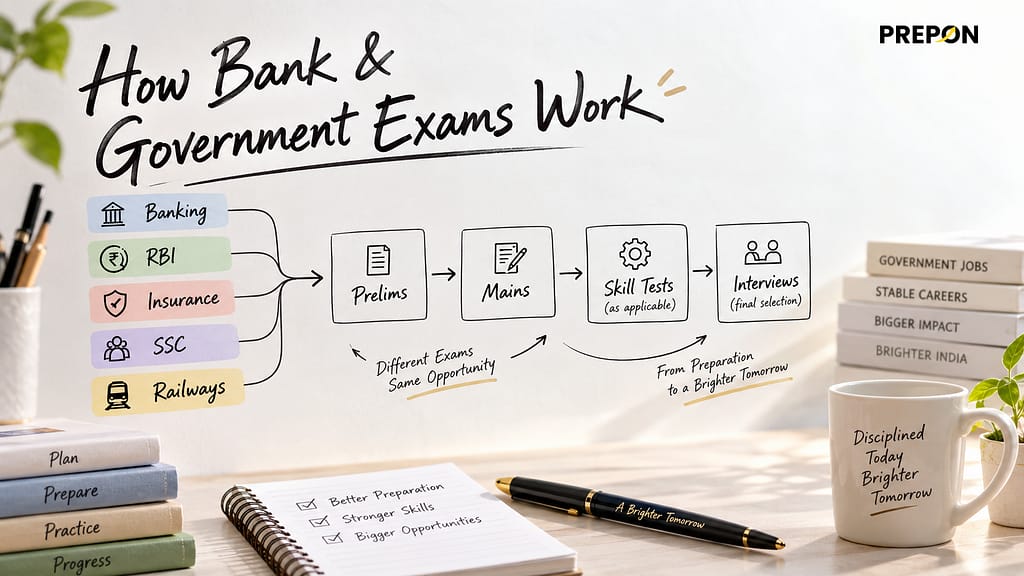
If you are preparing for bank or government recruitment, understanding the hierarchy helps you compare opportunities more intelligently. PREPON’s Bank & Government Test preparation resources can then help with the exam and interview side of that journey.
PREPON — Results. Not Just Resources.