Many aspirants treat SSC CGL as a four-subject, 60-minute aptitude test. The exam structure asks for more than that. A sound SSC CGL 2026 preparation strategy has to account for Tier 2, where the deeper syllabus, the qualifying components and the final merit structure sit.
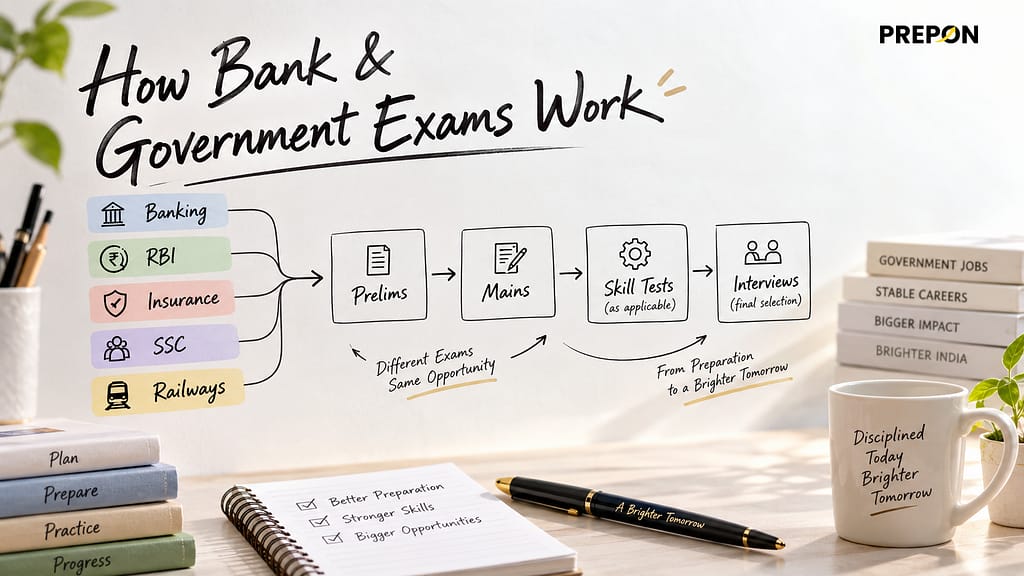
For broader preparation across Bank and Government exams, also see how Bank & Government exams work.
SSC conducts several recruitment exams, each with different academic, technical, language, skill and physical demands. SSC CGL is a graduate-level, aptitude-oriented exam with a deeper Tier 2 structure.
This article recommends building Tier 2 depth early, then sharpening Tier 1 speed and execution closer to the exam. In 2026, that speed has a specific meaning: performing well inside fixed, subject-wise timers. The article maps the wider SSC ecosystem briefly, then gives a practical roadmap covering subjects, previous-year questions, mocks, error analysis and adaptable study plans. It also separates official SSC facts from PREPON recommendations.
Major SSC Exams and What Preparation Each Requires
SSC runs several recruitment exams. They differ in qualification level, in the balance between aptitude, language, technical, skill and physical components, and in what preparation should emphasise. Details can vary by notification, so check the official notice for any exam you plan to attempt.
A short orientation helps before the table. CHSL and MTS draw on a similar aptitude base at a lower qualification level, so their preparation is lighter in depth. CPO and GD add physical and medical stages, so fitness preparation runs alongside the written syllabus. JE is driven by a core engineering subject, which makes technical mastery the priority. Stenographer and Hindi Translator exams are driven by skill and language, so shorthand accuracy or translation ability matters more than a broad aptitude spread. Selection Post changes by phase and post, so it needs post-specific reading.
| Exam | Typical qualification | Core written areas | Technical / skill / physical component | Preparation emphasis | How it differs from CGL |
|---|---|---|---|---|---|
| SSC CGL | Graduation | Reasoning, General Awareness, Quantitative Aptitude, English; deeper Tier 2 papers | Computer Knowledge Test and DEST; post-specific papers for some posts | Integrated academic depth across all four areas | Broadest academic scope, with a deeper second stage |
| SSC CHSL | 12th pass | Reasoning, General Awareness, Quantitative Aptitude, English | Typing or skill test for certain posts | Core aptitude and English at a lighter depth | Lower qualification level and generally lighter depth |
| SSC MTS & Havaldar | Typically 10th pass | Reasoning, numerical aptitude, General Awareness, English | Physical standards typically apply to Havaldar posts | Basic aptitude, accuracy and awareness | Lower academic depth; physical component for some posts |
| SSC CPO | Graduation | Reasoning, General Awareness, Quantitative Aptitude, English | Physical and medical standards | Aptitude plus physical readiness | Physical stages carry weight alongside the written exam |
| SSC GD Constable | Typically 10th pass | Reasoning, General Knowledge, elementary mathematics, language | Physical and medical standards | Basic aptitude plus physical fitness | Simpler written syllabus, strong physical focus |
| SSC JE | Typically engineering diploma or degree | General Awareness, Reasoning, plus a core engineering subject | Branch-specific technical content | Technical subject mastery | Engineering knowledge replaces a broad aptitude spread |
| SSC Stenographer Grade C & D | Typically 12th pass | Reasoning, General Awareness, English | Stenography skill test | Language accuracy plus shorthand skill | Skill-test driven; narrower written syllabus |
| SSC Selection Post | Varies by post | Varies by post | Varies by post | Post-specific preparation | Qualification and pattern change with each phase |
| Combined Hindi Translators / JHT-type | Typically a Master’s degree with language requirements | Language and translation papers | Descriptive language-based assessment | Language proficiency and translation skill | Language specialisation, not general aptitude |
Across the general aptitude-oriented SSC exams, SSC CGL requires the broadest integrated academic preparation.
SSC CGL 2026 at a Glance
| Parameter | Detail |
|---|---|
| Notification | Issued 21 May 2026; reference F. No. HQ-C11018/1/2026-C-1 |
| Application period | 21 May to 22 June 2026; reopened/extended up to 25 June 2026 |
| Fee payment deadline | 26 June 2026 |
| Correction window | 1 to 3 July 2026 |
| Tier 1 window | 30 September to 30 October 2026 |
| Vacancies (tentative/provisional) | Latest tentative revised figure: 10,731 |
| Tier 1 structure | 100 questions, 200 marks; 25 questions each in Reasoning, General Awareness, Quantitative Aptitude and English |
| Tier 1 timing | Sectional: 15 minutes each for Reasoning, General Awareness, Quantitative Aptitude and English (60 minutes in total) |
| Tier 2 Paper I (compulsory for all posts) | Mathematical Abilities: 30 questions, 90 marks, 30 minutes. Reasoning & General Intelligence: 30 questions, 90 marks, 30 minutes. English Language & Comprehension: 45 questions, 135 marks, 40 minutes. General Awareness: 25 questions, 75 marks, 20 minutes. Section III Computer Knowledge Test: 20 questions, 60 marks, 15 minutes, qualifying. Section IV DEST: approximately 2,000 key depressions, 15 minutes, qualifying |
| Paper I schedule | Conducted in Session I and Session II on the same day |
| Negative marking | Tier 1: 0.50 per wrong answer. Tier 2: 1 mark per wrong answer in relevant 3-mark objective components |
| Qualifying components | Tier 1 (screening); Computer Knowledge Test; DEST |
| Paper II | Statistics, for candidates shortlisted for Junior Statistical Officer (JSO) and Statistical Investigator Grade II |
| Paper III | General Studies (Finance & Economics), for candidates shortlisted for Assistant Audit Officer / Assistant Accounts Officer |
DEST is mandatory for all posts, subject to the limited exemption provisions specified by SSC for eligible PwBD-OH candidates and applicable post conditions.
Always confirm dates and operational instructions on the official SSC website before acting on them.
Why SSC CGL 2026 Needs an Integrated Tier 1-to-Tier 2 Strategy
An effective SSC CGL 2026 preparation strategy starts from one fact: Tier 1 is the screening gate. It does not contribute to final merit, but you must clear it to move forward. That makes it essential, and it is why this strategy never treats Tier 1 as optional.
Tier 2 is where final merit is built. It demands more depth and volume than Tier 1. English alone carries 45 questions and 135 marks, and each correct answer in the relevant components is worth 3 marks.
Computer Knowledge and DEST are qualifying but mandatory. Under SSC’s rules, candidates must qualify the required sections of Paper I separately. Their marks do not add to merit, but they cannot simply be ignored.
This reasoning is an inference from the exam structure, not an SSC statement. If you postpone every Tier 2-specific topic until Tier 1 is over, you compress the time available for advanced Maths, English volume, Computer Knowledge and typing readiness. This article does not assume any fixed gap between the two tiers, so plan on the basis of the official schedule.
Depth built early also helps Tier 1. Strong concepts make questions faster and more accurate. Speed work becomes more valuable as Tier 1 approaches.
In 2026, speed has a precise meaning. In Tier 1, it means performing efficiently inside four fixed 15-minute subject windows. In Tier 2, it means performing efficiently inside fixed subject-specific blocks of 30, 30, 40 and 20 minutes.
This is a PREPON recommendation, not a guarantee. Outcomes depend on your starting level, consistency and how well you learn from your mistakes.
SSC CGL Tier 1 vs Tier 2: What Actually Changes?
| Parameter | Tier 1 | Tier 2 |
|---|---|---|
| Purpose | Screening gate; does not contribute to final merit | Final merit is based on Tier 2 performance: Paper I for general posts, with Paper II or Paper III also applicable to the relevant shortlisted post categories. |
| Subjects | Reasoning, General Awareness, Quantitative Aptitude, English | Mathematical Abilities, Reasoning, English, General Awareness, Computer Knowledge, DEST |
| Questions | 100 (25 per subject) | Maths 30, Reasoning 30, English 45, General Awareness 25, Computer 20 |
| Marks | 200 | Maths 90, Reasoning 90, English 135, General Awareness 75, Computer 60 (qualifying) |
| Timing | Sectional: 15 minutes per subject, four fixed windows | Subject-wise: Maths 30, Reasoning 30, English 40, General Awareness 20, Computer 15, DEST 15 minutes |
| Negative marking | 0.50 per wrong answer | 1 mark per wrong answer in relevant 3-mark objective components |
| Conceptual depth | Core concepts across four subjects | Generally greater depth and volume, especially in Maths and English |
| Speed requirement | High: 25 questions inside each 15-minute window | Subject-specific pacing inside longer fixed blocks |
| Computer Knowledge | Not tested | 20 questions, 60 marks, 15 minutes, qualifying |
| DEST | Not tested | Approximately 2,000 key depressions, 15 minutes, qualifying; mandatory for all posts, subject to SSC’s limited exemption provisions for eligible PwBD-OH candidates and applicable post conditions |
| Paper II | Not applicable | Statistics, for JSO and Statistical Investigator Grade II shortlisted candidates |
| Paper III | Not applicable | General Studies (Finance & Economics), for AAO / Assistant Accounts Officer shortlisted candidates |
| Preparation implication | Fast, accurate selection inside 15-minute windows | Depth, stamina and accuracy inside fixed subject blocks; readiness for qualifying components |
Paper I is conducted in Session I and Session II on the same day.
What this means for your preparation
Your SSC CGL 2026 preparation strategy has to serve both stages at once. Tier 1 rewards fast, accurate selection inside four fixed windows. Tier 2 rewards depth, stamina and accuracy inside longer subject-specific blocks. The two overlap heavily in syllabus, but they differ in how much each topic is stretched.
Because every subject has its own timer, you cannot rely on moving time from one subject to another. A slow start in one subject cannot be repaid from another. You need subject-specific pacing for every subject, built through practice.
In practice, do not stop at Tier 1-level comfort in Maths and English. Keep Computer Knowledge and typing practice running alongside, not left for later.
How the 2026 Sectional Timers Change Your Preparation
This is the most practical change in the 2026 structure, so it deserves its own explanation. Both tiers now run on fixed subject-wise timers.
| Stage | Subject | Time |
|---|---|---|
| Tier 1 | Reasoning | 15 minutes |
| Tier 1 | General Awareness | 15 minutes |
| Tier 1 | Quantitative Aptitude | 15 minutes |
| Tier 1 | English Comprehension | 15 minutes |
| Tier 2 | Mathematical Abilities | 30 minutes |
| Tier 2 | Reasoning & General Intelligence | 30 minutes |
| Tier 2 | English Language & Comprehension | 40 minutes |
| Tier 2 | General Awareness | 20 minutes |
| Tier 2 | Computer Knowledge Test | 15 minutes |
| Tier 2 | DEST | 15 minutes |
The preparation consequences below follow from this structure. They are PREPON’s reading of it, not SSC guidance.
Mock design. Prefer sectional mocks that copy the real window: 15 minutes for a Tier 1 subject, and 30, 30, 40 and 20 minutes for the Tier 2 subjects. A full mock that lets you roam freely across a single 60-minute clock does not train the real skill.
Practice format. Practise each subject independently, with its own timer. Do not rely on a strong subject to rescue a weak one on the day.
Pacing. Learn how many questions you can realistically process inside each window. Your sectional mocks will show this over time. Avoid copying anyone else’s attempt numbers.
Skipping decisions. Skipping now happens inside a single subject’s window. Decide quickly whether a question is worth your time, and move on if it is not.
Section-specific stamina. English runs for 40 minutes in Tier 2, so sustained reading and accuracy matter. General Awareness runs for 20 minutes, so recall needs to be quick and clean.
Revision priorities. Revise in a way that helps under a timer. Short formula lists, rule sheets and compact GK notes are more useful than long, unstructured material.
Verify operational instructions, such as navigation and review options within each section, from official SSC communications. Do not assume how the interface behaves.
Treat these timers as the practical backbone of your SSC CGL 2026 preparation strategy, because they shape how you practise every subject.
SSC CGL 2026 Preparation Strategy: The 6-Phase Framework
This 6-phase SSC CGL 2026 preparation strategy is a PREPON recommendation. The phases overlap and can be compressed or expanded to suit your timeline. They show an order of emphasis, not fixed weeks.
Phase 1 — Diagnostic & Foundation
Start with a diagnostic mock or paper to see where you stand. Treat the score as a starting point, not a prediction of your result. Take one subject at a time under its real window where you can, so you see how each fixed timer feels.
- Arithmetic basics and number sense
- Grammar fundamentals
- Basic reasoning patterns
- An initial structure for General Awareness
- Keyboard familiarity, so typing does not start from zero later
Phase 2 — Topic Mastery
Work through topics one by one in Quant, Reasoning, English and General Awareness. Use recent topic-wise PYQs to anchor each topic to real exam questions. Computer Knowledge begins here, in short and regular sessions.
Phase 3 — Sectional Testing
Move from topic practice to timed sectionals, using the real windows. In Tier 1 terms, that means 15 minutes for each subject. Track accuracy, not just scores. Identify weak topics, and create your error log in this phase, using the format given later in this article.
Phase 4 — Tier 1 Speed Calibration
Speed now means working efficiently inside four fixed 15-minute subject windows. Use sectional and full Tier 1 mocks to learn how many questions you can realistically process in each window. Work on scanning, easy-first selection, skipping and negative-marking discipline.
There is no fixed number of mocks to reach. Frequency should follow your schedule and your ability to analyse each attempt.
Phase 5 — Tier 2 Elevation
Raise the depth and endurance of your preparation to match the Tier 2 blocks. That means deeper Maths for a 30-minute window, independent Reasoning practice for 30 minutes, higher English volume for 40 minutes and quick recall for a 20-minute General Awareness block. Add Computer Knowledge consolidation, DEST practice and longer timed sets.
The foundations for all of these were already laid in earlier phases, so this phase extends them rather than starting from scratch.
Phase 6 — Full Tier 2 Simulation
Rehearse the real structure subject by subject: Maths 30 minutes, Reasoning 30 minutes, English 40 minutes, General Awareness 20 minutes, then the Computer Knowledge Test for 15 minutes and DEST for 15 minutes. Pay attention to concentration and fatigue across a long exam day. Spend the final stretch on revision rather than new topics.
Quantitative Aptitude & Mathematical Abilities
Maths is where the depth gap between Tier 1 and Tier 2 is most visible. Tier 2 Mathematical Abilities carries 30 questions and 90 marks inside a 30-minute window. Advanced topics should not be postponed, and your practice must work inside that window. For deeper topic coverage, see PREPON's guide on Quantitative Aptitude for Bank & Government Exams.
In any SSC CGL 2026 preparation strategy, Maths deserves early and steady attention, because its depth cannot be built quickly.
| Layer | Topics | Preparation implication |
|---|---|---|
| Foundation | Percentages, ratio and proportion, averages, profit and loss, simple and compound interest, time and work, time-speed-distance | Build these first. They support almost everything else and are needed in both tiers. |
| Advanced | Number system, algebra, geometry, mensuration, trigonometry, data interpretation, statistics and probability topics where officially applicable | Start alongside the basics, not after Tier 1. These demand depth and are central to Tier 2 Maths. |
Check the official syllabus for the exact topics that apply.
Recommended method
Concept → Examples → Topic-wise PYQs → Timed Sets → Mixed Sectionals → Error Analysis
Build concept clarity before learning shortcuts. Shortcuts help only when you know why they work.
Practise calculation efficiency as a skill, and revise formulas regularly. In geometry, draw the diagram every time, because it often reveals the solution.
Mixed practice matters too, because the exam does not announce the topic before each question. Run your timed sets and mixed sectionals inside 15-minute (Tier 1) and 30-minute (Tier 2) windows.
Reasoning & General Intelligence
Reasoning rewards pattern recognition and clean representation. It is not automatically easy or scoring. Performance depends on how well you have practised each pattern family.
In Tier 2, Reasoning has its own 30-minute block. Practise it independently, because you cannot borrow time from Maths. A sound SSC CGL 2026 preparation strategy treats Reasoning as a separately timed skill, not a subject to rescue at the last minute.
Topics to cover:
- Analogy
- Classification
- Series
- Coding-decoding
- Syllogism
- Venn diagrams
- Mathematical operations
- Directions
- Blood relations
- Non-verbal reasoning
- Spatial reasoning
- Figure-based questions
- Statement-based reasoning
A practical method:
- Identify the pattern family of each question.
- Learn a clean way to represent it, such as a diagram, a table or a tree.
- Practise untimed first, then move to short timed sets.
- Analyse the questions that took you longest.
- Build skip discipline, so one stubborn question does not drain your window.
For guidance on this subject, see PREPON’s reasoning preparation resources.
English Language & Comprehension
Tier 2 English carries 45 questions and 135 marks in a 40-minute block. That is substantial merit weight, so it should not be treated as a quick-scoring subject. It needs structured preparation and sustained performance across the full 40 minutes.
For this reason, English deserves a fixed place in your SSC CGL 2026 preparation strategy from the early phases.
Areas to cover:
- Grammar
- Vocabulary
- Sentence correction
- Error spotting
- Fill in the blanks
- Cloze passages
- One-word substitutions
- Idioms
- Spelling
- Narration
- Voice
- Sentence rearrangement
- Comprehension
Use this framework:
Rule → Usage → PYQ → Contextual Reading → Revision
Learn the rule, see how it appears in sentences, then test it on PYQs. Reading builds the context that makes vocabulary and comprehension stick.
Useful sources include editorials, long-form articles, exam passages and quality nonfiction. Reading is one option among several, not a requirement. What matters is regular, active practice.
For more on this area, see PREPON's English preparation guide for competitive exams.
General Awareness
SSC does not publish official topic-wise weightage for General Awareness. Plan your preparation across the broad areas and avoid assuming how many questions any one topic will bring.
General Awareness runs for 15 minutes in Tier 1 and 20 minutes in Tier 2, so it rewards rapid, accurate recall. A fact you cannot retrieve quickly is of little use under a timer. Within your SSC CGL 2026 preparation strategy, this subject needs a light but regular revision habit.
Static areas
- Polity
- History
- Geography
- Economics
- Science
- Culture
- Static GK
Build these from one reliable source and revise them repeatedly. Static topics change slowly, so repeated revision pays off.
Current affairs
- Keep concise notes rather than long ones.
- Consolidate monthly.
- Revise selectively, based on what you can recall.
- Test yourself repeatedly, because recall fades.
Keep the time you spend here proportionate. General Awareness is only one part of the exam, and Maths, Reasoning and English carry most of the marks.
Computer Knowledge
The Computer Knowledge Test in Tier 2 is Section III of Paper I. It has 20 questions, 60 marks and a 15-minute duration. It is qualifying in nature.
Topics to cover:
- Computer fundamentals
- Hardware and software
- Operating systems
- MS Office
- Internet
- Networking
- Cyber security basics
- Common keyboard shortcuts
Under SSC’s rules, candidates must qualify the required sections of Paper I separately. A qualifying component does not add to your merit score, but it still has to be cleared. A mandatory test that you have not prepared for creates avoidable risk in an otherwise strong attempt.
Short, regular sessions starting from Phase 2 are usually enough to build familiarity. A dedicated SSC CGL Computer Knowledge and DEST article is planned.
DEST Preparation
The Data Entry Speed Test is Section IV of Paper I. It has the following official features:
- Approximately 2,000 key depressions
- 15 minutes
- Qualifying in nature
- Mandatory for all posts, subject to the limited exemption provisions specified by SSC for eligible PwBD-OH candidates and applicable post conditions
Like Computer Knowledge, DEST is a qualifying component that cannot be ignored. Its marks do not add to merit, but it must be cleared.
PREPON recommends the following approach:
- Start early, so typing becomes familiar rather than stressful.
- Practise briefly but regularly rather than in rare, long sessions.
- Prioritise accuracy before speed.
- Practise under timed conditions as the exam approaches.
- Become familiar with the test format described in the official instructions.
Refer to the official notification for test conditions and qualifying criteria.
If You Are Targeting JSO, AAO or Posts with Physical/Medical Standards
Some posts need preparation beyond the common Paper I. Check the official notification for post-wise requirements before finalising your preferences.
JSO / Statistical Investigator Grade II
Paper II (Statistics) applies to candidates shortlisted for Junior Statistical Officer (JSO) and Statistical Investigator Grade II. It requires additional subject preparation. Verify the qualification requirements in the official notification.
AAO / Assistant Accounts Officer
Paper III (General Studies, Finance & Economics) applies to candidates shortlisted for Assistant Audit Officer / Assistant Accounts Officer. It also requires additional subject preparation. Verify the current post and eligibility details in the official notification. For pay-level context, see PREPON's guide on Government Pay Scale in India.
Posts with physical or medical requirements
Some inspector and enforcement-type posts carry additional physical or medical standards. Check the official post-wise requirements before choosing your preferences.
How to Use SSC CGL Previous-Year Questions Properly
Previous-year questions show how the exam asks, not just what it asks. They are a core tool in any SSC CGL 2026 preparation strategy when used in stages:
- Topic-wise PYQs
- Mixed-topic PYQs
- Full previous shifts
- Timed reattempts
- Error-log revision
Recent papers deserve greater weight because they more closely reflect the current exam structure. Older PYQs can still help with concept practice.
When you reattempt PYQs, time yourself by subject, using the 15-minute Tier 1 and the 30-, 30-, 40- and 20-minute Tier 2 windows. A previous paper solved without these limits does not show how you would perform under the real timers.
PYQs reveal:
- Concepts that the exam tests
- Phrasing patterns
- Common traps
- Timing problems
- Your personal weaknesses
Treat PYQs as a practice and diagnostic tool, not a prediction device. A dedicated SSC CGL PYQ article is planned.
SSC CGL Mock Test Strategy: What Matters More Than the Number of Mocks
There is no official or mandatory number of mocks. What matters is how well you use each one. The table gives indicative frequencies that you should adapt to your schedule. Mocks are where your SSC CGL 2026 preparation strategy gets tested against the real timers.
| Stage | Mock type | Indicative frequency | Main analysis focus |
|---|---|---|---|
| Foundation | Occasional diagnostic papers, ideally one subject at a time under its real window | Occasional | Baseline strengths and gaps |
| Mid-preparation | Sectional tests in 15-minute (Tier 1) and Tier 2 subject windows, plus some full mocks | Weekly or fortnightly full mocks, with sectionals in between | Topic-wise weakness, accuracy and pace per subject |
| Late Tier 1 | Full Tier 1 mocks and 15-minute sectionals | Frequent | Questions processed per window, skipping decisions and negative marking |
| Tier 2 | Subject-wise Paper I simulations (30, 30, 40, 20 minutes), Computer Knowledge and DEST practice | Regular | Subject-specific pacing, stamina and accuracy |
After every mock, review:
- Accuracy
- Time spent in each subject window
- Questions skipped
- Wrong attempts
- Guessed questions
- Topic-wise weakness
- Repeated errors
For a deeper approach, see PREPON's guide on mock-test analysis.
The PREPON 7-Category Error Log
An error log turns mistakes into a revision plan. This is a PREPON framework, not an official SSC tool.
| Error Type | What it means | How to identify it | Corrective action |
|---|---|---|---|
| Concept Error | You did not know or misunderstood the underlying idea | You cannot solve it even without a time limit | Revisit the concept and solve a graded set |
| Calculation Error | The method was right but the arithmetic was wrong | The working shows a slip | Do calculation drills and keep working neat |
| Reading Error | You misread the question, option or a negative word | Re-reading the question reveals the miss | Underline keywords and read slowly the first time |
| Recall Error | You studied it but could not retrieve it | You recognise the answer immediately on review | Use spaced revision and short recall tests |
| Question Selection Error | You spent time on a trap or skipped an easy question | Compare time spent with marks gained | Set a skip rule and use a two-pass approach within the section |
| Time Management Error | You know the subject but leave questions unseen because you spent too long early in a fixed 15-, 20-, 30- or 40-minute section | Your sectional time log shows heavy early spending and unattempted questions at the end | Set checkpoints inside each window and practise with sectional timers |
| Guessing Error | You guessed without enough elimination and lost marks | Track the accuracy of your guesses | Guess only after eliminating options, mindful of the negative marking |
Use a simple log like this:
| Question / Topic | Error Category | Root Cause | Corrective Action | Revision Date |
|---|---|---|---|---|
| Time and work question | Concept Error | Unclear efficiency method | Revise the concept and solve five similar questions | Next revision |
Follow this process:
Attempt → Review → Classify → Correct → Revisit
No log can guarantee a score improvement. It simply makes your mistakes visible and gives each one a fix.
Tier 1 Attempt Strategy
In 2026, Tier 1 uses sectional timing. Each of the four subjects has its own 15-minute window: Reasoning, General Awareness, Quantitative Aptitude and English Comprehension. Each has 25 questions.
This changes how you approach the paper. The question is not which subject to attempt first, or how to split 60 minutes. It is how to use each fixed 15-minute block well.
Verify operational instructions from SSC, including how navigation, review and movement between questions work within a section. Do not assume interface behaviour.
Using each 15-minute block
- Begin with a quick scan of the questions. Notice which look easy and which look heavy.
- Take easy questions first, so you secure marks before the clock tightens.
- If the interface permits it within the same section, skip a stubborn question and return to it. Confirm this in the official instructions first.
- Avoid time traps. A question that has already taken far longer than average rarely repays more time.
- Protect accuracy. Each wrong answer costs 0.50 marks, so a careless attempt can cancel out part of a correct one.
Subject-specific pacing
Each subject calls for different pacing, because the questions behave differently.
- Quantitative Aptitude: Calculation-heavy questions take longer. Pick the quicker ones first and leave lengthy calculations for later in the window.
- Reasoning: Pattern questions are usually fast once you spot the pattern. Practise a clean representation so you do not lose time on set-up.
- English Comprehension: Grammar and vocabulary questions are usually quicker than a passage. Plan how you will handle the comprehension questions inside the window.
- General Awareness: You either recall a fact or you do not. Move quickly, and do not stall on something you cannot retrieve.
Learn your own numbers
Use sectional mocks to learn how many questions you can realistically process inside 15 minutes in each subject. Your numbers will differ by subject and will change as you improve. Avoid borrowing a fixed attempt target from anyone else.
What this replaces
Because the timers are fixed, advice that treats Tier 1 as one freely divisible 60-minute paper does not apply. You cannot choose a section order or bank spare minutes from one subject for another. Your preparation should instead build sound pacing in every subject.
Tier 2 Attempt Strategy
Paper I has subject-wise timers. These are official structure facts:
- Mathematical Abilities: 30 minutes
- Reasoning & General Intelligence: 30 minutes
- English Language & Comprehension: 40 minutes
- General Awareness: 20 minutes
- Computer Knowledge Test (Section III): 15 minutes
- DEST (Section IV): 15 minutes
Paper I is conducted in Session I and Session II on the same day.
Candidates cannot rely on transferring time from one subject to another. Each subject needs its own pacing, built in advance.
Practical points, drawn from this structure:
- Maths (30 minutes): Do not let one long question absorb your window. Take accessible questions first and treat lengthy ones with caution.
- Reasoning (30 minutes): Practise it independently from Maths. A good Maths session does not give you extra Reasoning time.
- English (40 minutes): Sustained reading and accuracy matter for the full block. Build stamina through longer timed sets.
- General Awareness (20 minutes): Rapid recall matters. Move on from facts you cannot retrieve.
- Accuracy: Wrong answers cost 1 mark in the relevant components, so careless guesses are expensive.
- Concentration: Sustained focus matters across a full exam day.
Check the official instructions for operational details of the exam interface, including navigation and review options. Do not assume rules that SSC has not stated.
SSC CGL Study Plans: 6 Months, 3 Months, 60 Days & 30 Days
These plans are PREPON recommendations. No timeline is enough for everyone. Your starting level, consistency and analysis decide how far any plan takes you. Each one is a version of the same SSC CGL 2026 preparation strategy, scaled to the time you have.
| Plan | Main objective | PYQ role | Mock role | Tier 2 integration |
|---|---|---|---|---|
| 6 Months | Build the full foundation, then move to Tier 2 depth and sectional speed | Topic-wise first, then mixed sets | Occasional early, then sectionals, then full mocks | Computer Knowledge and typing from the start |
| 3 Months | Compress the foundation and prioritise core topics | Heavy topic-wise and mixed use | Begin sooner, with close review | Parallel thread for advanced Maths, English volume, Computer Knowledge and DEST |
| 60 Days | Targeted coverage with minimal new resources | Central, with timed reattempts | Early and regular, with strict error-log use | Brief, regular Computer Knowledge and typing sessions |
| 30 Days | Revise, simulate and execute | Timed reattempts and error-log revision | Frequent sectionals and full mocks | Keep Computer Knowledge and DEST practice running |
6 Months
For early starters.
- Objective: Build the full foundation, then move through mastery to Tier 2 depth and sectional speed.
- Syllabus priority: Cover all four subjects properly, including advanced Maths and English depth.
- PYQ role: Start with topic-wise PYQs and move to mixed sets over time.
- Mock role: Occasional diagnostics early. Add sectional tests in the real 15-minute windows in the middle phase, and full mocks later.
- Revision: Regular weekly revision cycles.
- Tier 2 integration: Start Computer Knowledge and typing early, and practise Tier 2 subjects in their own 30-, 30-, 40- and 20-minute blocks.
3 Months
For candidates with a reasonable base.
- Objective: Compress the foundation and prioritise core topics.
- Syllabus priority: High-use topics first, with advanced Maths and English volume running alongside.
- PYQ role: Heavy use of topic-wise and mixed PYQs.
- Mock role: Begin mocks sooner, use 15-minute sectionals, and review each attempt closely.
- Revision: Short, frequent revision of formulas, rules and notes.
- Tier 2 integration: Keep a parallel thread for Computer Knowledge, DEST and Tier 2 subject timers.
60 Days
For intensive preparation with prioritisation.
- Objective: Targeted coverage with minimal new resources.
- Syllabus priority: Cover your highest-return areas first. Accept that some gaps will remain.
- PYQ role: Central, through topic-wise practice and timed reattempts by subject.
- Mock role: Early and regular, with strict error-log use.
- Revision: Daily short revision.
- Tier 2 integration: Brief, regular Computer Knowledge and typing sessions.
30 Days
For revision, mocks, pacing, Computer Knowledge and DEST.
- Objective: Revise, simulate and execute.
- Syllabus priority: Revisit what you already know. Avoid starting large new topics.
- PYQ role: Timed reattempts and error-log revision.
- Mock role: Frequent sectionals and full mocks, with careful review of pacing inside each window.
- Revision: Focus on notes, formulas and your error log.
- Tier 2 integration: Keep Computer Knowledge and DEST practice running.
For more planning support, see the SSC CGL study plan guide planned for PREPON.
Preparing While Working or Studying
You do not need to study a fixed number of hours every day. Build a routine around the time you realistically have. An SSC CGL 2026 preparation strategy works best when it fits your actual schedule.
Core building blocks:
- Two focused weekday study blocks
- Short revision slots
- A weekend mock
- A backlog block
- A priority topic block
| Week type | Weekday study | Revision | Weekend |
|---|---|---|---|
| Lighter week | Two shorter focused blocks | A few short slots | One sectional or a partial mock |
| Standard week | Two focused blocks | Short daily slots | One full mock plus review |
| Heavier week | Two longer blocks, with extra practice where possible | Daily slots | A full mock, a backlog block and a priority topic block |
Minimum viable week: Keep one focused session on your priority topic, a few short revision slots and one error-log review. Busy periods happen. Keeping the habit alive matters more than perfect weeks.
Common SSC CGL Preparation Mistakes
Most preparation gaps come from a handful of avoidable habits. Use the table as a quick self-audit.
| Mistake | Why it hurts | Better approach |
|---|---|---|
| Preparing only for Tier 1 | Leaves Tier 2 depth and qualifying components underprepared | Build Tier 2 depth early and add Tier 1 speed later |
| Delaying advanced Maths | Compresses the time for harder topics | Start advanced topics alongside the basics |
| Ignoring English depth | English carries 135 marks in Tier 2 | Use a structured English system |
| Over-investing in current affairs | Takes time from heavier-weight subjects | Keep notes concise and revise regularly |
| Passive lecture consumption | Watching feels like learning but is not practice | Solve questions after each concept |
| Solving without analysis | Mistakes repeat | Log and classify errors |
| Mocks without review | The mock teaches little | Review every mock in detail, including time spent in each window |
| Chasing attempts instead of accuracy | Negative marking erodes the score | Prioritise accurate attempts |
| Ignoring Computer Knowledge | A mandatory qualifying test is left to chance | Practise in short regular sessions |
| Postponing DEST | Typing readiness needs time | Start early and practise briefly but regularly |
| Switching resources too often | Revision stays shallow | Stay with a small, trusted set |
| Not understanding target-post requirements | Post-specific papers or standards surprise you late | Read the official notification early |
Resource Strategy: Minimum Resources, Maximum Revision
PREPON recommends fewer resources and more revision. Collecting materials is not the same as preparing.
| Resource type | Role | Guidance |
|---|---|---|
| Official syllabus | Defines what to study | Read it first and keep it as your reference |
| One concept source per subject | Builds understanding | Choose one and finish it before adding another |
| One PYQ source | Shows exam patterns | Use it in the staged way described above |
| Sectional tests | Build pacing inside each subject window | Use the real 15-minute and Tier 2 subject timers |
| Full mocks | Rehearse the exam | Take them in line with your stage and analyse each one |
| Revision notes | Support quick recall | Keep them short and revisit them often |
| Vocabulary and grammar system | Supports English | Follow one structured method consistently |
| Static GK and current-affairs source | Supports General Awareness | Use a concise source and revise repeatedly |
| Computer Knowledge source | Supports the qualifying test | Use short, regular sessions |
If you use any specific book or platform, treat it as optional. What matters is that you finish what you start and revise it repeatedly. For a wider view of competitive exam preparation, see PREPON's Bank & Government Exam Preparation resources.
Frequently Asked Questions
How should I start preparing for SSC CGL 2026?
Begin your SSC CGL 2026 preparation strategy with a diagnostic, ideally one subject at a time under its real timer. Then fix your arithmetic, grammar and reasoning basics. Add short, regular Computer Knowledge and typing practice alongside, and follow the 6-phase framework at your own pace.
Can SSC CGL be prepared in 6 months?
Many candidates plan their preparation over roughly six months. Results depend on your starting level, consistency and how well you analyse your mistakes. No timeline guarantees an outcome.
Is 3 months enough for SSC CGL?
It can be workable for candidates with a decent academic base and clear priorities. Gaps are likely, so prioritisation and mock analysis matter. It is not enough for everyone.
Should Tier 2 preparation start before Tier 1?
In PREPON's SSC CGL 2026 preparation strategy, Tier 2-level depth is built from the beginning, and Tier 1 speed is sharpened closer to the exam. Tier 1 remains the screening gate, so it must still be cleared.
Is SSC CGL Maths difficult?
Difficulty depends on your background and practice. Tier 2 Mathematical Abilities generally demands more depth than Tier 1, inside a 30-minute window. A method of concept, practice and error analysis helps.
How many mocks should I take?
There is no official or fixed number. Frequency should rise as the exam approaches. Sectional mocks that copy the real subject timers, plus careful analysis, matter more than the count.
Are PYQs enough?
PYQs are essential for understanding patterns, but they are not a complete strategy. Combine them with concept study, sectionals, mocks and error analysis.
Is Computer Knowledge compulsory?
Yes. The Computer Knowledge Test is Section III of Tier 2 Paper I, with 20 questions, 60 marks and 15 minutes. It is qualifying in nature, and candidates must qualify the required sections of Paper I separately under SSC's rules. Prepare for it.
Is DEST compulsory?
DEST is mandatory for all posts, subject to the limited exemption provisions specified by SSC for eligible PwBD-OH candidates and applicable post conditions. It involves approximately 2,000 key depressions in 15 minutes and is qualifying in nature. Confirm details in the official notification.
Which SSC exams have similar preparation?
CHSL and some Selection Post phases overlap with CGL in aptitude, English and General Awareness, usually at a lighter depth. Check each notification for the exact pattern.
What is the difference between SSC CGL and CHSL preparation?
CGL is a graduate-level exam with a deeper Tier 2 structure. CHSL is typically a 12th-level exam with lighter depth. The main differences are in depth, volume and post structure.
Can working professionals prepare for SSC CGL?
Yes, with a realistic routine. An SSC CGL 2026 preparation strategy built on two focused weekday blocks, short revision slots and a weekend mock can work. Outcomes are never guaranteed, so focus on consistency.
Which SSC exam is suitable for graduates?
It depends on your goals, skills and eligibility. CGL is the main graduate-level, aptitude-oriented exam. Others, such as CPO, JE or Hindi Translator exams, suit specific profiles.
Does SSC CGL Tier 1 contribute to final merit?
No. Tier 1 is the screening stage and does not contribute to the final merit score. Candidates still have to clear it to reach Tier 2, so it remains an essential part of preparation.
How much time is available for each SSC CGL Tier 1 subject in 2026?
Each Tier 1 subject has a fixed 15-minute window in 2026: Reasoning, General Awareness, Quantitative Aptitude and English Comprehension. Preparation should therefore include subject-wise timed practice rather than treating Tier 1 as one freely divisible 60-minute paper.
What are the SSC CGL Tier 2 subject-wise timers?
Tier 2 Paper I uses fixed subject-wise timers: Mathematical Abilities 30 minutes, Reasoning & General Intelligence 30 minutes, English Language & Comprehension 40 minutes and General Awareness 20 minutes. Computer Knowledge has 15 minutes, and DEST also has 15 minutes.
Conclusion
A sound SSC CGL 2026 preparation strategy treats Tier 1 and Tier 2 as one connected journey. Tier 1 is the gate you must clear, and Tier 2 is where depth, accuracy and stamina count. In both, speed means working well inside fixed subject timers.
Start today with three steps:
- Take a diagnostic.
- Build your Phase 1 plan.
- Create your error log.
If you want structure along the way, PREPON offers mentoring, accountability, mock analysis and progress tracking. No plan guarantees an outcome, but a disciplined one gives you the best chance to use your time well.